
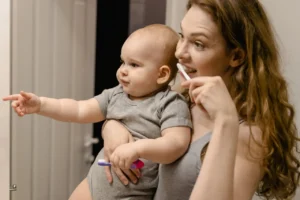
I remember staring at my baby’s perfect gummy smile, soaking in the cuteness… and then seeing a post that said, “You should already be cleaning their gums.”
I blinked. Cleaning what now ?
Between feeding schedules, diapers, naps (or lack thereof), and just trying to drink my coffee while it’s warm, oral hygiene for baby felt like one more thing on an already overflowing list. Was it really that important before teeth? Could I mess it up? Was fluoride safe? What about bottles at night ?
If you’re wondering the same things—hi, friend. I’ve been there, too.
The good news? Baby oral care does not have to be complicated. Small, simple habits can:
- prevent painful cavities,
- protect those adorable first teeth,
- and build lifelong healthy routines.
Let’s walk through it together in clear, real-mom language—with evidence-based tips, zero judgment, and lots of grace.
In this article : [+]
1. Start Before the First Tooth : Gums Need Love Too
Oral hygiene for baby actually starts before that first tiny tooth pops through.
Even with a gummy smile, milk residue and bacteria can build up in your baby’s mouth. Cleaning gently :
- reduces bacterial buildup,
- keeps breath fresher (yes, baby breath can get funky),
- helps your baby get used to mouth care, so brushing later isn’t a shock.
How to do it :
- Use a clean, soft, damp washcloth or gauze.
- Gently wipe :
- gums,
- tongue,
- inside cheeks.
- Aim for :
- at least twice a day, especially after the last feeding before bedtime.
This takes 20 seconds and sets the tone: “We take care of our mouth.”
Mom note :
I started doing this while we rocked before bed—he thought it was a game, and it secretly made me feel like I had one tiny thing under control.
2. First Tooth = First Toothbrush (Yes, Right Away)
As soon as you spot that first little tooth (usually around 6 months, but totally normal if earlier or later), it’s toothbrush time.
What you need :
- A baby-sized, soft-bristled toothbrush.
- A tiny smear of fluoride toothpaste—about a grain-of-rice amount.
Current guidance from groups like the AAP, ADA, and AAPD recommends :
- Start fluoride toothpaste as soon as teeth appear, using a smear/rice-sized amount up to age 3.
How to brush :
- Brush twice a day :
- morning,
- and especially before bed.
- Lay baby in your lap with their head on your knees or chest so you can see.
- Use gentle circular motions:
- along the gum line,
- on all sides of each tooth.
- No need to rinse—leaving a tiny bit of fluoride helps protect the enamel.
It will feel awkward. They will chew the brush. That’s okay. The goal is consistency, not perfection.
3. How Much Toothpaste? (The Rice vs. Pea Debate, Simplified)
Here’s the easy breakdown based on major dental organizations :
- From first tooth to age 3 :
👉 Use a smear of fluoride toothpaste, about the size of a grain of rice. - From age 3–6 :
👉 Use a pea-sized amount of fluoride toothpaste (once they can spit).
Why fluoride?
- It strengthens enamel,
- helps prevent cavities,
- and, at these tiny amounts, is considered safe and recommended.
If you’re unsure for your local water/fluoride situation, ask your pediatrician or pediatric dentist before using supplements—don’t guess.
Mom note :
I used to panic about swallowing. The smear is so tiny that it’s okay if they can’t spit yet. That guideline exists for exactly that reason.
4. Don’t Sleep with Sugar : Bottles, Nursing & Nighttime Habits
One of the biggest causes of early cavities is what we call “baby bottle tooth decay” or early childhood caries.
Cavities can start earlier than you think—and they hurt.
To protect baby’s teeth :
- No bottles in bed with :
- formula,
- breast milk,
- juice,
- or any sugary drink.
- If your baby needs a comfort bottle at sleep:
- use plain water (if age-appropriate and approved by your pediatrician), or
- feed milk, then brush/wipe and put them down.
Why?
- Sugars pool around the teeth overnight,
- bacteria feed on sugar → produce acid → damage enamel.
For breastfeeding :
- Nursing is beautiful and healthy.
- When baby has teeth and feeds frequently overnight:
- try to gently wipe or brush when possible,
- and talk with your pediatrician or pediatric dentist if you’re concerned about cavity risk.
Also :
- Avoid juice before 12 months (AAP recommendation),
- Limit sugary snacks and drinks as they grow.
You are not “mean” for protecting their teeth. You are future-you’s hero.
5. Flossing & Those Cute Little Tooth Gaps
Flossing sounds wild for a baby, but here’s the key rule :
👉 Once two teeth are touching, you can start flossing between them.
Why?
- Bacteria and food get trapped in tight spaces,
- brushing alone might not reach them.
How to make it doable :
- Use gentle baby flossers (the little handled ones),
- One quick swipe between touching teeth at night is enough,
- Turn it into a silly ritual (we used sound effects—shockingly effective).
You’re not failing if you don’t get every gap, every night. Just start the habit.
6. Keep Your Germs to Yourself (With Love)
Babies aren’t born with cavity-causing bacteria; they usually catch them from… us.
To lower that risk :
- Try not to :
- share spoons,
- blow on their food,
- “clean” pacifiers with your mouth.
- If you do sometimes (because life), it’s okay—just aim for awareness, not perfection.
Bonus : Taking care of your own teeth (brushing, flossing, seeing your dentist) also helps reduce the bacteria you might pass on.
7. Make Brushing Fun (So It’s Not a Daily Wrestling Match)
Real talk : some babies and toddlers act like brushing is a betrayal. Totally normal.
A few mom-tested tricks :
- Start early & keep it playful
If you’ve been wiping gums since newborn days, brushing feels more familiar. - Let them “help”
Give them a toothbrush to chew while you brush with another. - Sing a toothbrushing song
Make up a 30–60 second song and sing it every time. Repetition = routine. - Use the mirror
Babies love seeing themselves. Brush in front of a mirror so they can watch. - Count teeth together
“1…2…3…tiny teeth!” — reinforces language and makes it a game.
If they clamp their mouth, fuss, or twist away :
Aim for a few good swipes, praise them, and try again later. Little by little is still progress.
8. First Dental Visit : Earlier Than Most People Think
This one surprises a lot of parents (it did me) :
Most pediatric dental and medical organizations recommend:
👉 First dental visit by age 1, or within 6 months of the first tooth.
This visit is usually :
- quick,
- gentle,
- mostly about :
- checking tooth and gum health,
- talking about habits,
- answering questions,
- creating a “dental home.”
You are not showing up to be judged. You’re showing up to get support.
Mom note :
I was weirdly nervous for our first visit, but it ended up being reassuring. He sat on my lap, they peeked in, gave stickers, and I left thinking, “Okay. We’re okay.”
9. Expert Insight (In Simple, Mom-Friendly Words)
Here’s the science backbone behind these tips :
- AAP, ADA & AAPD recommend :
- cleaning gums even before teeth come in,
- brushing twice a day as soon as the first tooth erupts,
- using a smear (grain-of-rice size) of fluoride toothpaste under age 3, and pea-sized from 3–6, with supervision. HealthyChildren.org
- scheduling the first dental visit by age 1 or within 6 months of the first tooth.
- Fluoride toothpaste in recommended amounts helps prevent cavities and is considered safe for infants and young children. AAPD
- Avoiding prolonged bottle use with sugary liquids and not putting baby to bed with milk/juice significantly reduces early childhood caries risk. Pediatrics At The AAPD
Easy blog disclaimer you can use :
This post is for educational purposes only and does not replace advice from your pediatrician or pediatric dentist. Always consult your child’s healthcare providers for personalized guidance.
10. Gentle Encouragement : You’re Not Behind, You’re Learning 💛
If you’re just now thinking, “Oh… I haven’t really been wiping gums or brushing every night,” take a breath.
Your baby’s teeth are not ruined.
This isn’t too late.
You’ve been learning on the go while feeding, soothing, working, surviving, and loving a tiny human—that matters.
Tiny shifts from today forward truly add up:
wipe gums a bit more often,
add a rice-sized smear of toothpaste at bedtime,
book that first dental visit,
swap one bedtime milk bottle for water or an earlier feed.
Simple, doable steps. One at a time.
Perfection is not the requirement here. What your little one needs most is a present, caring mama—the kind who’s reading about baby oral hygiene because she wants to do right by her child.
That already speaks volumes about you.
You’ve got this. 🦷✨
11. Let’s Share the Real-Life Stuff
If this guide on oral hygiene for baby helped simplify things :
- Tell me in the comments: Where are you in the journey? Gummy smile? First tooth? Toddler who bites the toothbrush?
- Share your funniest or most chaotic brushing moment—another mama needs to know it’s not just her.
- Know a pregnant or new mom who has no idea she’s supposed to clean gums yet (like most of us)? Send this her way with a kind, “You’ll love this, no pressure.”
- Want more cozy, research-backed, zero-judgment guides on baby health, sleep, feeding, and milestones? Join my email list so we can learn as we go—side by side. 💌