
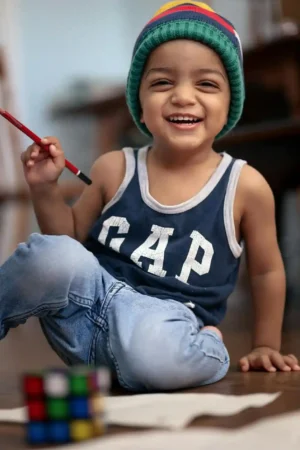
I really started thinking about Helping a toddler hold a crayon correctly the day I sat my little one at the table with a pile of fresh crayons and paper… and she grabbed the crayon like a tiny dagger and just stabbed the page.
Meanwhile, a friend sent me a photo of her child “writing their name” in adorable wobbly letters, and I’m over here celebrating that my kid managed to scribble on the paper instead of the wall.
My brain immediately went into mom-spiral mode :
- “Should she be holding it ‘properly’ by now ?”
- “Am I supposed to correct her grip ?”
- “Is this going to mess up her writing later ?”
If you’ve been there—looking at that chubby little fist around a crayon and wondering if you should worry—you are absolutely not alone. I’ve been there too. 💛
Here’s the good news: toddlers go through normal stages of crayon and pencil grasp, and a “wrong” grip at 2 years old is often just part of the process. Most kids don’t develop a mature tripod grasp (that classic three-finger hold) until somewhere between ages 4 and 6.
In this post, we’ll walk through :
- What’s typical for toddler crayon grips
- Simple tools and tricks that gently encourage a better hold
- Play-based activities that strengthen the tiny muscles needed for writing
- When it might be worth checking in with your pediatrician or an occupational therapist
No shaming. No forcing tiny fingers into perfect positions. Just practical, mom-tested ideas to support your child at their own pace.
In this article : [+]
1. First, Know What’s Normal for Toddler Crayon Grips
Before we try to “fix” anything, it helps to know what’s developmentally normal. Kids don’t wake up at age 2 with a perfect pencil grasp—they work through several stages :
- 1–2 years : Fisted grasp
Crayon is held in a fist (palmar grasp), often with the thumb on top. Movements come from the whole arm and shoulder. - 2–3 years : Digital pronate grasp
Crayon is still held with the whole hand, but now the palm faces down and the fingers start to wrap around more. - 3–4 years : Static tripod or quadrupod grasp
Crayon is held with 3–4 fingers (thumb, index, middle, sometimes ring), but movement still comes from the wrist or forearm—not yet from the fingers. - 4–6 years : Dynamic tripod or quadrupod grasp
The “mature” grip. Thumb, index, and middle finger (and sometimes ring finger) control the crayon, and the movement comes mostly from the fingers.
If your 2-year-old is still fisting a crayon, that doesn’t automatically mean something is wrong—they may just be in an earlier stage. The goal isn’t to force a 2-year-old into a 6-year-old grasp. The goal is to gently support them toward the next step.
Think: progress, not perfection.
2. Start with the Right Tools : Short, Chunky, and Easy to Hold
One of the easiest hacks for Helping a toddler hold a crayon correctly has nothing to do with complicated techniques—it’s just using the right size crayon.
Why smaller crayons help
When crayons are short, there simply isn’t enough room to use a big fist around them. Kids are more likely to use their thumb and fingers in a pinch-like grasp. Occupational therapists often recommend :
- Breaking regular crayons into small pieces
- Using golf pencils (short, stubby pencils)
- Choosing chunky crayons or triangular crayons
These encourage :
- Thumb and index finger “pinch”
- Better control
- Less awkward, overly tight grips
Easy swaps you can try
- Crayon pieces : Snap regular crayons into thirds or halves (bonus: less painful when they inevitably break).
- Bath crayons : Short and fun, plus kids can draw on tile.
- Sidewalk chalk : Chunky chalk encourages a more open hand and finger movement.
Mom moment :
I used to feel bad “breaking” crayons on purpose, but once I saw how naturally my child started using a more refined grip with the shorter pieces, I was converted.
3. Try Simple Grasp Tricks : Pinch, Flip, and Visual Cues
Once your toddler is ready (usually closer to 3+), you can introduce some playful techniques to guide their fingers without constant nagging.
The “Pinch and Flip” trick
- Lay the crayon on the table with the tip pointing toward your child.
- Ask them to pinch the tip with their thumb and index finger.
- Then help them “flip” it up into their hand so it rests on the web space between thumb and index finger.
This encourages a tripod-style grasp in a fun, repeatable way. Many OTs use versions of this technique to help kids learn where their fingers go.
Use a little “smiley face” reminder
- Draw a tiny smiley face or dot on the part of the crayon where their thumb should go.
- Tell them : “Thumb on the smiley!”
Visual cues are easier for toddlers to remember than long instructions about finger positioning.
Model and gently guide
- Show them how you hold the crayon.
- Gently adjust their fingers if they’re open to it.
- Keep it light: “Let’s try it this way, it might feel easier!” instead of “No, that’s wrong.”
Mom tip :
I’ve had way more success treating it like a fun “crayon trick” than a correction. If it starts a power struggle, we pause and try again another time.
4. Build Hand and Finger Strength Through Play (Not Worksheets)
Here’s a big secret : a good crayon grip starts long before the crayon.
Research shows that fine motor skills—like hand strength and dexterity—are strongly linked to later handwriting legibility. So if your toddler is struggling to hold a crayon, the answer isn’t always “more drawing.” Often, it’s more hand play.
Fun fine motor activities to try
- Playdough or putty
- Rolling “snakes”
- Pinching “cookies”
- Hiding beads or buttons in the dough and having your child dig them out
- Tongs and tweezers
- Use kid-safe tongs to pick up pom-poms, cotton balls, or cereal and drop them into containers.
- Sticker peeling
- Peeling small stickers off a sheet is amazing pincer-grasp practice.
- Threading and lacing
- Stringing chunky beads onto a shoelace or pipe cleaner.
- Clothespin games
- Clipping clothespins onto the edge of a box, plate, or piece of cardboard.
These activities :
- Strengthen hand and finger muscles
- Improve coordination and control
- Prepare your child to handle crayons and pencils without fatigue
Mom moment :
I used to worry that we weren’t doing enough “pre-writing.” Then our OT reminded me that squishing playdough and peeling stickers is pre-writing. That reframe helped a lot.
5. Use Vertical Surfaces for Better Wrist and Shoulder Support
One simple tweak that can make a big difference: draw on a vertical surface instead of always on a flat table.
Try :
- Taping paper to the wall
- Using an easel
- Drawing on a chalkboard or whiteboard
- Using window markers on a glass door (if you’re brave 😅)
Why vertical surfaces help :
- Encourage a more extended wrist position (better for fine motor control)
- Build shoulder and upper arm stability, which supports better hand movements later
- Make it easier for kids to use small, controlled motions instead of big, sweeping arm movements
You might notice their grasp naturally improving when their body is better aligned for control.
6. Check Posture and Setup : Little Bodies Need Support
It’s not just about the fingers—the whole body supports a good crayon grasp.
When your toddler is sitting to color :
- Feet supported
- Feet flat on the floor or resting on a box, not dangling.
- Table at the right height
- Elbows should rest comfortably on the table, not up by their ears.
- Stable trunk
- Sitting all the way back in the chair for better core support.
A stable body = more energy and control left over for those small hand movements.
If they prefer to lie on their tummy to color (on the floor with a paper in front), that’s okay too—it actually builds shoulder strength and can be great for some kids.
7. Keep It Fun, Not Frustrating
This part is huge: if working on grip becomes a battle, your toddler may start to avoid drawing altogether—which is the opposite of what we want.
A few gentle guidelines :
- Focus on fun, not perfect form.
- “Let’s draw a silly monster!” instead of “Hold it like this!” every 10 seconds.
- Praise effort and comfort, not just grip.
- “I love how you kept trying!”
- “Look how many colors you used!”
- Correct occasionally, not constantly.
- Aim for little nudges: “Let’s try the pinch-and-flip trick again!”
- Follow their interest.
- If they’re obsessed with trucks, draw roads and parking lots.
- If they love princesses, draw crowns and dresses together.
Mom note :
When I eased up on “fixing” every moment and focused more on us just enjoying the time together, my child’s grip improved anyway—because she was actually willing to pick up a crayon more often.
8. When (and How) to Use Pencil Grips or Special Tools
There are lots of pencil grips and special crayons out there—triangular grips, Grotto grips, molded supports. These can be helpful, but they’re not always necessary for every toddler.
They can be useful if :
- Your child is a bit older (3–4+) and still really struggles to place fingers correctly.
- They get frustrated easily and a grip gives them a clear “spot” for each finger.
- An occupational therapist has recommended a specific type.
If you decide to try one :
- Start with something simple, like a triangular grip or triangle crayons.
- Show your child how to hold it: “Thumb goes here, pointer here.”
- Use it for short, fun drawing sessions—not long, stressful ones.
Remember: grips are tools, not magic fixes. They work best alongside all those strength-building and play activities we talked about earlier.
9. When to Talk to a Pediatrician or Occupational Therapist
Every child develops at their own pace, and a slightly “funny” crayon hold in toddlerhood is usually not an emergency. But it can be helpful to check in with a professional if you notice things like :
- Your child avoids using their hands for drawing, stacking, feeding, etc.
- They seem unusually clumsy or weak with their hands compared to peers.
- They get very frustrated or tired quickly when trying to color or do fine motor tasks.
- At preschool age (4+), they still can’t manage any kind of controlled grip or basic pre-writing strokes (like simple lines and circles), despite lots of chances to practice.
Your pediatrician may :
- Reassure you that your child is still within a normal range, or
- Refer you to a pediatric occupational therapist for a closer look and tailored activities
Studies show that fine motor skills like hand strength and dexterity are closely tied to later handwriting legibility and school success. Getting extra support early can make things much easier down the road.
You are not “overreacting” by asking questions. You’re advocating for your child—and that’s powerful.
You’re Doing an Amazing Job, Mama
Mama, if you’ve ever watched your toddler fist a crayon and felt that flutter of worry in your chest—please know you’re not alone. 💛
You don’t have to turn your home into a therapy center or nail every single “right” technique. Every time you :
- Sit down and scribble together
- Offer little crayon pieces instead of full ones
- Pull out playdough, stickers, or tongs
- Gently guide their fingers with patience instead of pressure
…you’re helping build the foundations for future writing, independence, and confidence.
Small moments—one doodle, one sticker, one little “pinch and flip”—really do add up over time. You and your toddler are learning together, and there is so much grace in that.
You’ve got this. Truly. 💛
Let’s Share Ideas
I’d love to hear from you :
👉 What’s one simple thing that’s helped your child with holding a crayon—or just enjoying drawing more?
Share it in the comments—your idea might be exactly what another tired, worried mama needs to try this week.
If this post on Helping a toddler hold a crayon correctly was helpful, feel free to save it for later or share it with a friend. And if you’d like more cozy, judgment-free tips on child development, fine motor play, and mom life, you’re always welcome to join my email list for weekly encouragement and real-life ideas. 💌