
I remember sitting on the living room floor, surrounded by a mountain of toys—plastic lights, noisy buttons, random puzzle pieces—and my toddler was… bored. After five minutes, every toy was on the floor, no one was actually playing, and I was the one feeling overstimulated.
If you’ve ever thought, “There has to be a calmer way for my child to play,” you’re so not alone. That’s exactly when I started looking into Montessori Play Ideas for Toddlers and Preschoolers—and realized play doesn’t have to be loud, complicated, or Pinterest-perfect to be powerful.
Montessori-inspired play is all about simple, hands-on activities that let kids explore, practice real-life skills, and follow their curiosity. No fancy playroom required. A tray, a small basket, a pitcher of water, some blocks… and suddenly your child is deeply focused instead of bouncing from toy to toy.
Today, I’m sharing practical Montessori play ideas you can start using today—even if you don’t own a single “official” Montessori material. Think : easy setups, everyday items, and activities that grow with your child from toddler to preschooler.
Take a deep breath, mama. You don’t have to entertain your child every second. You just get to set up the invitation… and then watch the magic happen. 💛
In this article : [+]
1. What Is Montessori-Inspired Play (In Simple Mom Terms)?
Before we dive into the activities, let’s keep the “Montessori” part simple and not intimidating.
Montessori-inspired play is :
- Hands-on – Kids touch, pour, stack, scoop, sort, build, and explore.
- Child-led – You set up the activity, and then step back as much as possible.
- Real-life based – Lots of practical tasks: pouring water, washing toys, preparing snacks.
- Orderly and calm – Fewer toys, displayed neatly on low shelves or trays, so kids can focus on one thing at a time.
You don’t need :
- A perfect, wooden-only playroom
- Expensive “Montessori” branded materials
- A huge budget or tons of time
If you can offer your child :
- A few simple, accessible activities
- A bit of freedom to explore
- And your calm, patient presence
…you’re already doing Montessori at home.
2. Setting Up a Simple Montessori Play Space at Home
You don’t need a special room—just a small corner that feels calm and inviting.
Keep It Low and Accessible
- Use a low shelf, TV stand, or even the bottom shelf of a bookcase.
- Place 3–6 activities on the shelf at your child’s level (fewer for toddlers, a bit more for preschoolers).
- Use small baskets, bowls, or trays so each activity is contained and visually clear.
Less Is More
Montessori emphasizes quality over quantity. Instead of a huge toy bin full of everything, try :
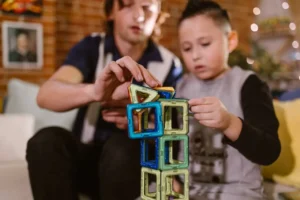
- 1–2 building toys (like blocks or magnetic tiles)
- 1 practical life activity (like pouring or spooning)
- 1–2 sensorial activities (like sorting or playdough)
- 1 open-ended toy (like play silks or animal figures)
When toys are out of control, your child doesn’t know what to do with them—and honestly, neither do we. When I reduced our toy shelf, my child’s attention span instantly improved. It felt like magic.
Rotate, Don’t Add
If your child seems “over” an activity :
- Put it away for a week or two and rotate in something else
- Later, bring it back and watch how it feels “new” again
This keeps play fresh without constant buying.
3. Practical Life Play : Everyday Tasks as Powerful Learning
Montessori is big on practical life skills—and toddlers LOVE them. It’s their way of saying, “Let me do it myself!”
These activities are perfect for both toddlers and preschoolers (just adjust difficulty).
1. Pouring & Transferring (Ages ~18 months+)
What you need :
- A small pitcher (plastic or metal)
- Two cups or bowls
- Water, dry rice, beans, or pom-poms
- A small towel or sponge for spills
How it works :
Show your child how to pour from one container to the other slowly. Then let them try. For toddlers, start with water in the sink or on a tray. For preschoolers, try smaller containers and challenge them to pour without spilling.
Why it’s amazing :
- Builds hand–eye coordination and focus
- Teaches cause and effect
- Gives a sense of independence (“I can do it!”)
In our house, the “rice pouring tray” lived on a low shelf for weeks. My child kept going back to it over and over, and I just quietly refilled it during nap time.
2. Snack Preparation (Ages ~2–5 years)
Ideas :
- Peeling a banana
- Spreading peanut butter or cream cheese on crackers or toast
- Cutting soft fruits (like strawberries or cucumbers) with a child-safe knife
- Putting berries into a bowl
Setup :
- Use a small cutting board, blunt child-safe knife, and a tiny bowl.
- Show each step slowly: hold with one hand, cut with the other, fingers tucked back.
Why it’s helpful :
- Encourages healthy eating
- Builds fine motor skills
- Supports pride and confidence (“I made my snack!”)
Is it messier than you doing it yourself? Yes.
Is it worth it? Absolutely. You’re not just making a snack—you’re raising a capable human.
3. Laundry & House Care (Ages ~2–5 years)
Simple Montessori-style chores :
- Sorting socks by color or size
- Transferring clothes from basket to washer
- Folding washcloths or napkins in half
- Dusting low surfaces with a small cloth
- Watering plants with a tiny watering can
These aren’t “chores” in a negative way; they’re important invitations to be part of family life. Toddlers feel so proud when they have a real job.
4. Sensorial & Fine Motor Montessori Play Ideas
Montessori sensorial activities help children explore textures, sizes, colors, and shapes.
4. Sensory Bins with a Purpose
What you need :
- A shallow container or bin
- A base: rice, oats, dried beans, pasta, kinetic sand, or water
- Tools: scoops, spoons, cups, funnels, tongs, ladles
- Optional: small objects to “hide”
How to use :
- For toddlers: scooping, pouring, filling and dumping
- For preschoolers: sorting by size, color, or type; using tongs; counting items
Skills supported :
- Fine motor skills
- Concentration
- Early math concepts (more/less, full/empty, counting)
Yes, it can get messy—but a towel or cheap plastic tablecloth under the bin helps a lot. And remember : the mess is often where the learning is.
5. Color Sorting & Matching (Ages ~18 months–5 years)
Materials :
- Muffin tin or small bowls
- Pom-poms, buttons, blocks, or LEGO pieces in different colors
Activity :
- Toddlers : place one color in each section (you can add color stickers at the bottom as guides).
- Preschoolers : sort by multiple attributes (color + size, color + shape), or use tongs for a fine motor challenge.
This can be as simple or complex as you want, and it takes minutes to set up.
6. Mystery Bag or Box (Ages ~2–5 years)
How to do it :
- Take an opaque bag or box
- Add a few household items with different textures:
- Spoon
- Small ball
- Soft cloth
- Block
- Hairbrush
- Invite your child to reach in without looking and guess what they’re feeling.
This builds language, sensory awareness, and memory. Preschoolers can even describe the object (“It feels bumpy and hard… maybe a block!”).
7. Playdough Trays (Ages ~1.5–5 years)
Instead of handing over a big lump of playdough and 20 tools, try a simple tray:
- A small ball of playdough
- A few loose parts: shells, buttons, sticks, small rolling pin, cookie cutter
You can :
- Make faces
- Create pretend food
- Press patterns (forks, blocks, toy wheels)
Playdough is incredible for finger strength and creativity. And yes, they will probably taste it once. It’s a toddler rite of passage. 😅
5. Montessori Play Ideas Specifically for Toddlers (1–3 Years)
Toddlers thrive on simple, repetitive, hands-on activities.
Here are some toddler-friendly Montessori invitations :
- Posting Activities
- Use an empty oatmeal container with a slit in the lid
- Give your toddler playing cards, large popsicle sticks, or chunky coins to “post” through the slot
- Great for focus and hand–eye coordination
- In-and-Out Baskets
- Fill a small basket with clothespins, wooden rings, or blocks
- Show your toddler how to take everything out and put it back in
- It seems basic, but toddlers LOVE mastering this
- Simple Matching Games
- Match socks, lids to containers, or picture cards to actual objects
- Start with very obvious pairs and slowly increase difficulty
- Car Ramp or Ball Run
- Use a cardboard ramp, balance board, or folded piece of cardboard
- Roll balls or cars down and talk about “fast/slow,” “up/down”
- Water Play with a Purpose
- A small tub of water, a sponge, and a few toys to wash
- Say, “Let’s give your animals a bath!”
Keep toddler activities short and inviting. If they only last five minutes but your child is fully engaged, that’s a win.
6. Montessori Play Ideas for Preschoolers (3–5 Years)
Preschoolers are ready for a bit more complexity, problem-solving, and imagination.
1. More Advanced Practical Life
- Cutting Soft Foods :
Let them slice bananas, strawberries, or soft cheese with a child-safe knife. - Sweeping Crumbs :
Provide a small broom and dustpan and show them how to sweep into a pile. - Simple Food Prep :
Making a fruit salad, stringing fruit onto skewers (with supervision), or making their own mini sandwiches.
These activities build responsibility and confidence, and they genuinely help you, too.
2. Early Math & Sorting Trays
- Sorting buttons by size, shade, or number of holes
- Lining up shells or stones by size from smallest to largest
- Counting out snacks into bowls (“Can you put 3 crackers in each bowl?”)
Preschoolers love feeling “big” and capable. These simple tasks build foundations for math without formal worksheets.
3. Language & Storytelling Play
- Story Basket :
Place a few figures (animals or people) and small props (a tree, a tiny house) in a basket and invite your child to “tell a story.” - Label Matching :
Write simple labels like “bed,” “door,” “table” on small cards and match them to real objects at home. - Picture Sequencing :
Print or draw simple picture cards showing steps of a routine (brushing teeth, getting dressed) and have your child put them in order.
This builds vocabulary, sequencing skills, and imagination.
7. Nature & Movement : Montessori Outside the Playroom
Montessori isn’t just shelves and trays—it’s also being in nature and moving their bodies.
Nature Walks & Treasure Hunts
On a walk, bring a small bag or basket and collect :
- Leaves
- Rocks
- Sticks
- Flowers (if allowed)
At home, your child can :
- Sort by size, color, or texture
- Count their treasures
- Make simple nature art by gluing them to paper
“Walk the Line” (Balance & Focus)
- Use painter’s tape to create a line on the floor
- Show your child how to walk heel-to-toe along the line
- For variation, walk:
- Backwards
- On tiptoes
- Carrying a small object on a spoon
Great for balance, concentration, and body awareness.
8. Key Montessori Principles to Keep in Mind (Without Overcomplicating It)
You don’t have to “do Montessori perfectly.” But these core ideas can guide you:
1. Use Child-Sized, Real Tools
Think mini broom, small pitcher, step stool, tiny apron. When tools fit their hands and bodies, kids feel capable instead of clumsy.
2. Offer Order and Simplicity
- Fewer toys, clearly displayed
- One activity per tray or basket
- A place for everything, and everything in its place
You’ll be amazed how much calmer it feels—for you and your child.
3. Follow the Child
If your child is deeply engaged in something (yes, even if it’s pouring water back and forth for 30 minutes), let them repeat. Repetition is how they master skills.
4. Support Independence (But Stay Nearby)
It’s okay to step back and let them struggle a bit with a zipper or pouring. You’re the safe base, but they get to be the explorer.
9. A Quick Word on the “Science” Behind This
Research shows that hands-on, play-based learning supports :
- Attention and concentration
- Problem-solving and creativity
- Emotional regulation and resilience
- Language and social skills
In other words, when your child is happily transferring beans from bowl to bowl, they’re not just “playing”—they’re building a powerful foundation for school and life.
You’re not “just” giving them something to do. You are supporting their brain and nervous system in the gentlest, most natural way.
Encouragement for Tired Moms (Because You Matter, Too)
Mama, if you’re reading this while tripping over toys and feeling guilty that you’re not doing “enough,” please hear this:
You do not need a Pinterest-perfect Montessori home, a wooden rainbow in every corner, or a rotation chart on your fridge. You just need a few simple Montessori Play Ideas for Toddlers and Preschoolers, a bit of space on a shelf, and your willingness to slow down and observe your child.
Every time you say, “Would you like to pour the water?” or “Can you help me fold these napkins?” you’re planting tiny seeds of confidence, independence, and joy.
Those seeds matter far more than fancy toys ever will.
You’re doing better than you think. Truly. 💛
Your Turn, Mama – Let’s Share Ideas!
I’d love to hear from you :
What Montessori-inspired activity does your little one enjoy the most?
Is it pouring water, washing toys, sorting snacks, or building with blocks?
Share it in the comments—your idea might be exactly what another tired mama needs today. 💬
And if you’d like more simple, realistic ideas for toddler and preschooler play (without the overwhelm), make sure to join my email list. I’ll send you cozy, mom-friendly tips, play prompts, and routines straight to your inbox.