
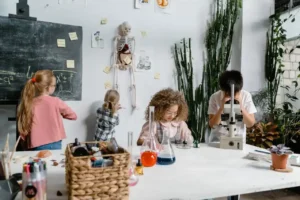
I still remember the first time I tried one of those “easy science experiments for kids” I saw on Pinterest. I had baking soda on the counter, vinegar in a cup, a toddler tugging on my leg, and about three minutes before someone needed a snack. In my head, it was going to be magical. In reality… half the “lava” went on the floor, my child shouted “AGAIN!” ten times, and I wondered if this counted as real learning or just a giant mess.
If you’ve ever wondered how to actually do STEM-Inspired Activities for Kids at home—without a special degree, fancy kits, or 2 hours of prep—I’m right there with you, mama.
The good news? Little kids don’t need complicated experiments. They learn best through simple, hands-on play with things you already have in your kitchen, craft drawer, or recycling bin. STEM (science, technology, engineering, and math) for toddlers and preschoolers is really about curiosity: What happens if I pour this? Stack that? Tilt this? Mix those ?
In this post, I’ll walk you through easy, low-prep STEM activities using simple materials, plus share how I actually fit them into everyday life. Think : more wonder, less overwhelm.
Grab your coffee (reheated for the third time, obviously), and let’s dive in.
In this article : [+]
1. Start with Simple Science : Kitchen Counter Experiments
The kitchen is basically a STEM lab in disguise. You don’t need anything fancy—just a few basics and a towel for spills.
1. Baking Soda Volcano
What you need :
- Small cup or jar
- Baking soda
- Vinegar
- A tray or large plate
- Optional : food coloring, playdough to build a “volcano”
What to do :
- Put the cup on the tray and fill it halfway with baking soda.
- Add a few drops of food coloring if you want colorful “lava.”
- Let your child pour vinegar into the cup and watch it fizz and bubble over.
How it builds STEM skills :
- Teaches basic cause and effect (“When we mix these two things, something happens!”).
- Introduces early chemistry ideas, even if you just call it “a reaction.”
- Encourages prediction : “What do you think will happen if we add more vinegar?”
Real mom note :
The first time I did this with my child, we spent more time saying “WOW!” than anything else. We repeated it three times in a row and that totally counted as science for the day.
2. “Magic” Color-Changing Milk
What you need :
- Shallow dish or plate
- Milk (enough to cover the bottom)
- Food coloring
- Dish soap
- Cotton swab
What to do :
- Pour milk into the dish.
- Add drops of different food coloring around the surface.
- Dip the cotton swab into dish soap, then gently touch the surface of the milk.
- Watch the colors swirl and “dance.”
How it builds STEM skills :
- Shows surface tension in a very visual way.
- Encourages kids to observe carefully and describe what’s happening.
- Promotes new vocabulary : swirl, mix, spread, slow, fast.
3. Sink or Float Challenge
What you need :
- Large bowl or tub of water
- A variety of objects: spoon, toy car, cork, rock, plastic lid, crumpled foil ball, etc.
- Towel underneath, because… water.
What to do :
- Before putting each object in the water, ask : “Do you think this will sink or float?”
- Let your child drop it in and see what happens.
- Sort objects into “sink” and “float” groups.
How it builds STEM skills :
- Introduces buoyancy and density in a hands-on way.
- Encourages hypothesis and testing: guessing, then checking.
- Builds language: heavy, light, float, sink, light as a feather, heavy as a rock.
Easy variation :
Let them test their toys : “Will your dinosaur float? What about your block?”
2. Rainbow Fun : Color Mixing and Walking Water
Kids LOVE color, and you can turn that love into STEM learning super easily.
4. Walking Water Rainbow
What you need :
- 6 clear cups or jars
- Paper towels
- Water
- Food coloring (red, yellow, blue)
What to do :
- Arrange the cups in a line: full–empty–full–empty–full–empty.
- Fill cups 1, 3, and 5 with water.
- Cup 1: red
- Cup 3: yellow
- Cup 5: blue
- Fold paper towels into strips and place them so one end is in a colored water cup and the other end is in an empty cup next to it.
- Wait and watch the water “walk” up the paper towels and into the empty cups, mixing colors along the way.
How it builds STEM skills :
- Shows capillary action (water moving up the paper towels).
- Teaches color mixing: red + yellow = orange, yellow + blue = green, etc.
- Encourages patience and observation over time.
Mom tip :
Set this up before snack time, then “check on the rainbow” every 10–15 minutes. It keeps them engaged without you hovering.
3. Engineering Fun : Towers, Bridges, and Simple Machines
Little kids are natural engineers. If your toddler has ever stacked blocks just to knock them down again—they’re already doing STEM.
5. Marshmallow or Cup Tower Challenge
What you need :
- Marshmallows or playdough balls
- Toothpicks (for older preschoolers) or plastic straws cut into pieces
- OR just paper cups for a cup tower
What to do :
- Challenge your child : “Can we build the tallest tower we can without it falling over?”
- Try different ways of stacking: wide base vs. skinny base.
- If you’re using cups, try building a “pyramid” or a long wall.
How it builds STEM skills :
- Teaches stability and balance in a very concrete way.
- Encourages trial and error: “That fell. Let’s try again another way.”
- Builds fine motor skills as they place and adjust pieces.
Real mom moment :
Sometimes the “tower” is two cups high and your toddler joyfully smashes it. That’s okay. The goal at this age is the process, not the perfect structure.
6. Build-a-Bridge Challenge
What you need :
- Stacks of books or two chairs to create a “gap”
- Craft sticks, LEGO bricks, cardboard strips, or blocks
- Small toy car or animal for testing
What to do :
- Set up the gap between books or chairs.
- Invite your child: “Let’s build a bridge strong enough for your car to cross.”
- Try different designs: flat sticks, overlapping, double layers.
- Test the bridge with the toy car: does it hold? Does it wobble?
How it builds STEM skills :
- Introduces basic engineering and design thinking.
- Promotes problem-solving: “Why did it fall? What can we change?”
- Encourages perseverance and resilience.
7. Popsicle Stick Catapult (for older preschoolers)
What you need :
- Popsicle sticks
- Rubber bands
- Plastic spoon
- Soft items to launch (cotton balls, pom-poms, mini marshmallows)
What to do (simple version) :
- Stack 5–6 popsicle sticks and secure each end with rubber bands.
- Place two sticks in a cross (like an X), band them together in the middle.
- Slide the big stack between the open ends of the cross and secure.
- Attach the spoon to one end with a rubber band.
- Put a cotton ball in the spoon, press down, and let it fly.
How it builds STEM skills :
- Demonstrates force and motion.
- Encourages kids to test different amounts of force: “What happens if I push harder?”
- You can even mark where each launch lands and compare distances—hello, early measurement!
4. Math in Everyday Moments (No Worksheets Needed)
STEM is not just science and explosions—math is a big part of it, and you can sneak it into normal family life without anyone groaning.
8. Kitchen Measurement Fun
What you need :
- Measuring cups and spoons
- Simple recipe (muffins, pancakes, or even just mixing oats and yogurt)
What to do :
- Let your child help pour, scoop, and level ingredients.
- Count out loud: “We need 1… 2… 3 scoops of flour.”
- Talk about sizes: “This is a full cup. This one is a half. Two halves make a whole.”
How it builds STEM skills :
- Introduces measurement, counting, and fractions in a real context.
- Builds sequencing skills: first we add this, then that.
- Encourages following simple directions.
9. Nature Scavenger Hunt and Sorting
What you need :
- Bucket or bag
- Paper plates or bowls for sorting
- A short list (optional): something rough, something smooth, something green, something tiny…
What to do :
- Go for a walk and collect leaves, rocks, sticks, flowers (whatever is safe and allowed in your area).
- At home, sort them :
- By color : green vs. brown
- By size : big vs. small
- By type : rocks vs. leaves, etc.
- You can also create patterns: rock–leaf–rock–leaf, and ask your child what comes next.
How it builds STEM skills :
- Encourages classification and sorting—foundations of math and science.
- Teaches patterns and early data skills (grouping things, comparing).
- Builds vocabulary : rough, smooth, tiny, huge, heavy, light.
10. Shape Hunt Around the House
What you need :
- Your home or backyard
- Optional : paper with shapes drawn (circle, square, triangle, rectangle)
What to do :
- Show your child a shape and say, “Let’s find things that are circles!”
- Hunt together : plates, clock, lid, wheels.
- Repeat with different shapes.
How it builds STEM skills :
- Builds geometry awareness in an age-appropriate way.
- Helps kids see math in the real world.
- Encourages observation and attention to detail.
5. STEM-Inspired Play : Low-Pressure, High Learning
You don’t need to turn your home into a mini science museum for your child to benefit from STEM play.
Here are some simple ways to keep it doable :
- Keep a “STEM basket.”
Toss in things like measuring cups, plastic pipettes, paper towels, baking soda, droppers, magnifying glass, craft sticks. Pull it out when you have an extra 10–15 minutes. - Let your child lead.
If they’d rather stir water than watch a volcano, that’s okay. They’re still learning about liquids, cause and effect, and motor skills. - Embrace (managed) mess.
Put a towel down, use a tray, and remind yourself: “This is learning, not just chaos.” Then throw everyone in the bath later if you need to. - Ask open-ended questions.
- “What do you notice?”
- “What do you think will happen if we…?”
- “How could we try this another way?”
These questions help your child think like a little scientist or engineer—even if you don’t mention the word “STEM” at all.
6. Expert Insight : Why STEM Play Matters (Even in Early Childhood)
Child development experts often highlight that young children learn best through hands-on exploration and play, not long lessons or worksheets. Simple, playful STEM activities :
- Strengthen problem-solving and critical thinking skills.
- Build early math and science foundations in a way that feels fun.
- Encourage curiosity, creativity, and resilience when things don’t go as planned.
Reading, pretend play, and open-ended toys all blend beautifully with STEM, too. When your child builds a block tower, pretends it’s a rocket ship, and then counts down from 5 to blast off—science, math, and imagination are all showing up to play together.
You don’t have to track every milestone or turn every activity into a “lesson.” Just know that all this experimenting and wondering is quietly wiring their little brains for future learning.
7. Encouragement for Tired, Trying-Their-Best Moms
Mama, if you’re thinking, “This all sounds great, but I’m exhausted and my sink is full of dishes”… I see you.
Here’s what I want you to remember :
- You don’t have to do all the activities.
Even one simple “sink or float” game this week is enough. - Short and sweet is perfect.
5–10 minutes of focused play can be more powerful than an hour of half-distracted time. - Your presence matters more than perfection.
Your child won’t remember if the volcano didn’t fizz “enough.” They’ll remember that you sat on the floor with them and said, “Wow, look at that!”
Small, playful moments really do add up. You are already your child’s favorite teacher—even when you feel like you’re winging it.
You’ve got this. 💛
8. Share Your Ideas, Help Another Mama
I’d love to hear from you!
- What’s your child’s favorite simple STEM activity ?
- Have you ever tried one of these experiments—or had a funny “STEM fail” story ?
👉 Share your experience or your favorite idea in the comments.
Another tired mama scrolling at midnight might read your comment and think, “Okay, I can try that tomorrow.”
And if you’d like more cozy, real-life ideas for play, learning, and mom life, join my email list so we can stay connected—you’ll get gentle, practical tips straight to your inbox.