
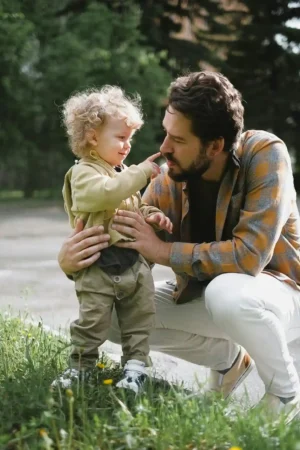
I remember one evening when my toddler spilled juice again after I’d already asked them three times to keep the cup on the table.
I felt that familiar wave of frustration rise up :
“Why don’t you ever listen ? Do I need to be stricter ? Am I being too soft ?”
Part of me wanted to snap, “No TV for a week!” (even though I knew I’d never actually follow through). Another part of me felt guilty for even thinking about punishments. I’d been reading about gentle parenting, Natural Consequences vs. Punishments parenting, and I honestly felt stuck in the middle.
Do I let everything slide and become the “pushover mom” ?
Or do I lay down the law and risk becoming the “scary mom” ?
If you’ve ever wondered the same thing, you’re definitely not alone. So many of us grew up with punishments—yelling, threats, spanking, taking things away “just because.” Now we’re trying to do things differently… but it’s not always clear how to actually do that in the middle of real-life messes and meltdowns.
In this post, we’ll break down the difference between natural consequences, logical consequences, and punishments in simple, mom-friendly language. I’ll walk you through real-life examples, easy scripts, and a step-by-step way to start shifting from fear-based discipline to teaching-based discipline.
Grab your coffee (or reheat it for the third time—I see you), and let’s walk through this together. 💛
In this article : [+]
1. Natural Consequences vs. Punishments: What’s the Real Difference?
Let’s keep it super simple.
Natural consequences
These are the direct results of a child’s choices, without you adding anything extra.
- They refuse to wear a coat → they feel cold outside.
- They leave their toy outside → it gets wet or dirty.
- They ignore their snack → they’re hungry later.
You don’t have to do much; the world does the teaching.
The goal is learning, not payback. It gently teaches :
“My choices have outcomes.”
Punishments
Punishments are things adults add on to make a child pay for a behavior.
- “You threw your toy, so no TV all week.”
- “You talked back, go sit alone in your room for an hour.”
- Yelling, shaming, name-calling (“You’re so naughty”).
They’re often not directly related to what happened. The goal is usually to control behavior quickly through fear, guilt, or shame.
Over time, this can teach :
“When I mess up, I’m bad… and I need to avoid getting caught.”
Logical consequences (the bridge between the two)
Logical consequences are set by the parent but are :
- related to the behavior
- respectful
- reasonable
- explained calmly
Example :
- Child throws blocks → blocks are put away for the rest of the morning.
- Child keeps drawing on the wall → crayons are for paper only; if used on walls again, they’re put away for the day and parent helps clean the wall.
Logical consequences are like a parent-guided version of natural consequences—still focused on teaching, not punishing.
2. Why Moving Away from Punishment Matters
A lot of us were raised with “Because I said so” and “Do you want me to give you something to cry about?”
So it’s normal to wonder :
“If I don’t punish, will my kid just turn wild?”
Here’s the thing :
- Punishments can work short-term because they scare or shame a child into stopping.
- But they don’t always teach what to do instead, or how to manage big feelings.
Many pediatric and mental health organizations now discourage physical and harsh verbal punishment (like spanking, hitting, yelling, or shaming) because research links these approaches to more behavior problems and poorer mental health over time.
Natural and logical consequences, on the other hand, can :
- build responsibility
- encourage problem-solving
- protect your relationship with your child
- teach them how the real world works
It’s not about letting kids “get away with it.” It’s about choosing discipline that teaches instead of scares.
3. When Natural Consequences Work (and When They Don’t)
Natural consequences can be incredibly powerful—when they’re safe and appropriate.
Great times to use natural consequences
- Coat battles
- They refuse a coat, it’s chilly but not dangerous → they get cold and might choose the coat next time.
- Toy care
- They throw a toy around outside, it breaks → they learn to treat toys more gently.
- Homework/chores for older kids
- They don’t study → they get a low grade and feel disappointed.
You stay calm, empathetic, and let reality do the teaching.
Script :
“You didn’t want to wear your coat and now you feel cold. That doesn’t feel good, huh? Next time you might choose your coat.”
When not to rely on natural consequences
Never use natural consequences when the outcome is :
- unsafe (running into the street, playing with knives, car seats)
- too severe for their age
- something they can’t understand yet
For safety issues, you step in with a firm boundary:
“Street is dangerous. I will hold your hand to keep you safe.”
Here, you might use a logical consequence instead (more on that below).
4. Logical Consequences : Teaching Without Shame
Logical consequences are your best friend when natural consequences are unsafe, too harsh, or just not clear enough.
Remember the key words :
- related
- respectful
- reasonable
Examples of logical consequences (that are not punishments)
- Throwing toys
- Behavior: Your toddler throws blocks at the wall.
- Logical consequence: “Blocks are for building, not throwing. If you throw them again, I’ll put them away.”
If they throw again → blocks go away for the morning.
- Coloring on the wall
- Behavior: They draw on the wall with crayons.
- Logical consequence: “Crayons are for paper, not walls. We’re going to clean this together. After that, crayons are put away for now.”
- Not coming when it’s time to leave the park
- Behavior: You say it’s time to go; they run the other way.
- Logical consequence: “You ran away when it was time to go. That tells me we’re not ready for a long park visit tomorrow. Tomorrow we’ll have a shorter playtime and try again.”
- Throwing food
- Behavior: They throw food off the highchair.
- Logical consequence: “Food is for eating, not throwing. If you throw again, that shows me you’re done eating.”
If they throw again → meal ends, calmly.
- Not taking care of belongings (older toddler/child)
- Behavior : Leaves favorite toy in the yard repeatedly.
- Logical consequence: “Toys that are left outside can get lost or broken. If it’s left outside again, we’ll put it away for a few days so we can remember to take care of it.”
You’re not “getting back at” them; you’re calmly connecting the dots between behavior and outcome.
5. Scripts to Use in Everyday Moments
Sometimes the hardest part is knowing what to say in the moment, especially when you’re tired and annoyed.
Here are some simple, mom-ready scripts you can keep in your back pocket.
When you’re holding a boundary
- “I know you’re upset. The answer is still no.”
- “I hear that you’re really mad. I won’t let you hit.”
- “You’re disappointed we’re leaving the park. It’s still time to go.”
When you’re using a natural consequence
- “You chose not to wear your boots, and now your feet are wet. It doesn’t feel good, does it?”
- “You didn’t eat your snack earlier, and now you feel hungry. We’ll eat again at dinner.”
When you’re using a logical consequence
- “Blocks are for building, not throwing. If they’re thrown again, I’ll put them away to keep everyone safe.”
- “Crayons are for paper. If you draw on the wall again, we’ll clean it together and crayons will be done for today.”
When you’re tempted to punish but want to switch gears
Instead of :
“You’re so naughty! No TV for a week!”
Try :
“You grabbed the toy from your sister. That hurt her feelings. Let’s give it back and you can try asking, ‘Can I have a turn when you’re done?’ If grabbing keeps happening, the toy will take a break for a while.”
You’re teaching problem-solving, not just enforcing silence.
6. Long-Term Effects : What Are We Really Teaching?
Let’s zoom out for a second and look beyond the immediate “stop that!” moment.
Over time, punishments can teach :
- “I’m bad when I make mistakes.”
- “I should hide what I do wrong so I don’t get in trouble.”
- “Power wins—whoever is bigger and louder gets their way.”
Research has linked physical and harsh verbal punishment (like spanking, slapping, or shaming) with higher risks of behavior problems, anxiety, low self-esteem, and negative parent–child relationships over time.Prevent Child Abuse America+3PMC+3aifs.gov.au+3
That doesn’t mean if you’ve ever yelled or punished, you’ve ruined your child (you haven’t!). But it does mean it’s worth gently moving toward approaches that build trust and skills instead.
Over time, natural and logical consequences can teach :
- “My choices have results, and I can learn from them.”
- “When I mess up, I can fix it and try again.”
- “My parents are calm, fair, and on my side—even when they say no.”
This is the kind of inner voice we want our kids to grow up with.
7. Discipline That Teaches Problem-Solving (Instead of Fear)
One of the biggest gifts we can give our kids is helping them learn how to fix things when they go wrong.
Here’s a simple 3-step approach you can use after things calm down:
1. Reflect
“Let’s talk about what happened.”
- Keep it short and simple.
- Let them share (even if it comes out in toddler-style words).
2. Name the impact
- “When you hit your brother, it hurt him and he felt sad.”
- “When you threw your cup, the juice spilled and now we have to clean it up.”
3. Brainstorm solutions together
Ask :
- “What can we do to make this better ?”
- “What could you do next time instead of hitting ?”
Offer ideas if they’re too young :
- “Next time you’re mad, you can say ‘Stop!’ or get a grown-up.”
- “Next time you’re frustrated, you can stomp your feet on the floor instead of throwing.”
This kind of problem-solving-focused discipline builds :
- empathy
- self-awareness
- responsibility
And it sends a powerful message :
“Your mistakes are not the end of the story. We can fix things together.”
8. A Simple Plan to Shift from Punishments to Consequences
If you grew up with punishments, changing your habits is a big deal. Be gentle with yourself. Here’s a simple way to start :
Step 1 : Pick one behavior
Maybe it’s :
- toy throwing
- hitting
- refusing to get into the car seat
- constant snack battles
Step 2 : Decide ahead of time
Ask yourself :
- Is there a natural consequence I can allow, as long as it’s safe?
- If not, what logical consequence makes sense that’s related and reasonable?
Write it down if it helps :
“If ____ happens, I will respond with ____.”
Step 3 : Practice your script
Say it out loud when you’re calm so it feels natural later :
“Food is for eating, not throwing. If you throw it again, we’re done with lunch.”
Step 4 : Expect pushback
Your child might test the new boundary at first. That doesn’t mean it’s not working. It means they’re learning that you mean what you say.
Step 5 : Repair when needed
If you end up yelling anyway (because, again, human!), come back and say :
“I’m sorry I shouted. I was feeling really frustrated. I’m working on staying calm when I’m upset, just like you.”
You’re modeling exactly what you’re trying to teach.
Encouragement : You’re Allowed to Learn and Grow Too 💛
Mama, if this all feels like a lot, take a deep breath.
You don’t have to switch from punishments to perfect natural/logical consequences overnight. You’re unlearning things you might have seen your whole life and trying to build something healthier for your child—and that is brave and beautiful.
Start small. Pick one situation, one script, one new response. Celebrate the tiny wins: the one time you stayed calm, the one time you used a logical consequence instead of a threat, the one time your child said, “I’m sorry” and tried again.
You are not a bad mom for having used punishments in the past. You are a growing mom for being willing to learn new tools now. And that growth will bless your child for years to come. 🌼
Let’s Talk About It
I’d love to hear from you :
👉 What’s one situation where you struggle with the balance between consequences and punishment—sharing, hitting, screens, bedtime, something else?
Share it in the comments, and if you’d like, tell me what you usually do now. I’m happy to help you brainstorm a natural or logical consequence and a simple script you can use next time. 💬
And if you want more gentle discipline tools, toddler behavior tips, and cozy mom support straight to your inbox, don’t forget to join my email list. We’re figuring this out side-by-side, one choice at a time. 💌