
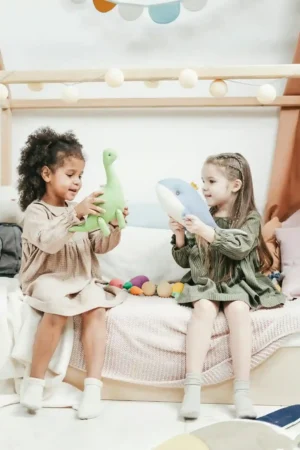
My very first “real” playdate as a mom did not look like the cozy Instagram photos I had in my head.
I’d set out snacks, put out all the “good” toys, and imagined the kids happily playing while the other mom and I sipped coffee and had actual adult conversation.
Instead…
- My child kept yelling “MINE!” at every toy.
- The other child burst into tears at least three times.
- Someone dumped an entire box of puzzles onto the floor.
- I spent most of the time playing referee, apologizing, and silently wondering if the other mom thought my kid was wild.
By the time they left, I was exhausted, my kid was overstimulated, and I seriously considered never hosting a playdate again.
Later, when I calmed down (and finally drank my cold coffee), I realized something:
I’d done zero prep.
No expectations.
No boundaries.
And, No plan.
Just a vague hope that “kids will play” and it would magically go smoothly.
If you’ve ever felt that same mix of stress, guilt, and “Maybe we’re just not playdate people,” I’m sending you a big hug. You’re not alone—and you’re definitely not failing.
With a few simple Playdate Tips—preparing your child, setting clear boundaries, and giving yourself realistic expectations—playdates can feel a lot calmer, kinder, and honestly… more fun.
Let’s walk through it together. 💛
In this article : [+]
1. Start with a Simple Expectations Chat
Before the playdate even starts, take a few minutes to talk with your child. This doesn’t need to be a long lecture—just a short, calm conversation.
What to cover
Keep it simple and concrete :
- Kind words
- “We use kind words with our friends.”
- “If you don’t like something, you can say, ‘I don’t like that.’”
- Hands and bodies
- “We keep our hands and feet gentle.”
- “If you feel mad, you can come tell me instead of hitting.”
- Sharing and taking turns
- “Some toys will be for taking turns.”
- “If your friend has a toy you want, you can say, ‘Can I have a turn when you’re done?’”
- Ask for help
- “If you’re having a problem, you can come and get me.”
Make it age-appropriate
For toddlers and preschoolers, you might keep it to 2–3 key rules :
- “Kind words.”
- “Gentle hands.”
- “Ask an adult for help.”
You can even turn it into a little chant :
“Kind words, gentle hands, ask for help!”
I like to do this chat while we’re getting ready—putting out snacks or tidying the living room—so it feels like part of the routine, not a heavy “serious talk.”
2. Role-Play Common Playdate Problems
Kids don’t magically know how to handle social situations—we have to teach them (and playdates are full of little challenges).
Role-playing at home helps your child feel more confident and prepared.
Simple scenarios to practice
Use stuffed animals, dolls, or just you and your child acting it out.
- When they want a toy
- You (as the friend): holding a toy
- Your child: “Can I have a turn when you’re done?”
- You: “Yes, I’ll give it to you when I’m finished.”
- When they don’t like what’s happening
- You: “Let’s play rough and tumble!”
- Child: “I don’t like that. Please stop.”
- When they need help
- You: “I took your toy.”
- Child: walks over to an imaginary you: “Mommy, I need help.”
Keep it short and light. You don’t need to turn it into a full drama—just a few rehearsed lines so your child has “scripts” ready in their brain.
I’ve found that even one or two little role-play moments before a playdate can make a big difference in how prepared my child feels.
3. Prep the Space : Put Away “Special” Toys and Define Play Zones
One of the biggest sources of drama during playdates? Special toys.
You know the ones:
The brand-new truck.
The extra-fancy doll.
The toy they suddenly love more than life itself the moment another child touches it.
Put away the “treasures”
Before the playdate, say :
“Are there any toys you don’t want to take turns with today?”
Let your child choose 1–3 special toys and put them in their room or a closet. Explain:
“These will stay safe. The toys out here are for taking turns with friends.”
This gives your child a sense of control and makes it easier for them to share what’s left.
Set clear play zones
If there are off-limits areas, be clear before guests arrive :
- “You and your friend will play in the living room and your bedroom with the door open.”
- “My office and the bathroom cupboard are off-limits.”
You can also quickly explain this to the visiting child (and parent), in a warm tone:
“The kids can play in the living room and [child’s name]’s room. The other rooms are for grown-ups today.”
A tiny bit of structure can prevent a lot of chaos.
4. Communicate with the Other Parent (Before Things Get Awkward)
I know it can feel a bit formal, but a quick check-in with the other parent before (or at the start of) the playdate can save everyone from confusion and uncomfortable moments.
Things to clarify
- Timing
- “Does 1.5–2 hours work? That seems to be my child’s sweet spot before they melt down.”
- Snacks and allergies
- “Any allergies or foods you’d like us to avoid?”
- Screens and rules
- “We usually keep screens off during playdates—is that okay with you?”
- “We play inside only / backyard is okay / trampoline with supervision only.”
- Discipline style
- “If there’s a conflict, I usually help them use gentle words and take a break if needed. How do you like to handle things with your child?”
This doesn’t need to be a big, heavy conversation—just a few minutes to get on the same page. Most parents really appreciate it.
5. Start Small : Short and Sweet Playdates
Especially for younger kids, shorter is better.
A 1–1.5 hour playdate is usually more than enough for toddlers and preschoolers. Once kids start getting tired, hungry, or overstimulated, things can go downhill fast.
Timing tips
- Avoid starting right before nap time or meals.
- Try late morning or early afternoon when kids have the most energy.
- If you’re not sure, err on the shorter side. You can always extend next time.
There’s no gold star for hosting a 4-hour playdate if everyone ends up in tears (including you). A short, mostly positive experience teaches your child, “Playdates are fun,” which makes future ones easier.
6. Be Present… But Don’t Hover
This is a tricky balance: you want to supervise for safety and help with the big conflicts, but you also want to give them space to practice social skills.
When to hang back
If the kids are :
- negotiating roles in pretend play
- mildly disagreeing (“I want to be the mom!” “No, I do!”)
- working out who goes first
…you can often stay nearby but silent.
Sometimes just your presence is enough for them to feel safe while they figure out little bumps.
When to step in
Step in calmly when you see :
- hitting, pushing, biting, or throwing
- a child clearly overwhelmed or cornered
- something unsafe (climbing furniture, rough play near hard edges)
You might say :
- “I’m going to help keep everyone safe. Hands are not for hitting.”
- “It looks like this game is getting too rough. Let’s take a break.”
Then you can help them restart with kinder behavior or switch activities.
Think of yourself as a gentle coach, not a referee blowing a whistle every 30 seconds.
7. Expect Big Feelings—and Support Them
Even with perfect preparation, playdates can stir up big emotions :
- jealousy
- frustration
- excitement
- overstimulation
All completely normal.
When your child is upset
If your child starts to melt down :
- Move them to a quieter corner or another room with you.
- Stay calm and steady.
- Name what you see :
- “You’re feeling really upset that your friend has your favorite truck.”
- “It’s hard when it’s time for them to go home and you want to keep playing.”
You can hold the boundary and validate the feeling :
“It’s okay to feel mad. It’s not okay to grab. Let’s take a breath together and then figure out what to do.”
If things feel too intense, it is absolutely okay to :
- switch to a calmer activity (books, drawing, water play)
- end the playdate a little early so it doesn’t crash and burn
Ending on a somewhat positive note is better than pushing through until everyone is overcooked.
8. Use Warnings for Transitions (Goodbye Tears Are Normal)
Saying goodbye is often the hardest part—for both kids.
To soften the transition, use countdown warnings :
- “10 more minutes of play, then it’s time to clean up.”
- “5 more minutes, then your friend will go home.”
- “Okay, 2 more minutes—choose one last game.”
For toddlers, you might pair it with something visual :
- an actual timer
- a small sand timer
- or even fingers: “This many minutes” (holding up fingers)
When it’s time to stop :
- Stay kind but firm.
- Acknowledge the feeling: “You wish the playdate could last longer. That means you had fun!”
Over time, your child learns that endings are part of life—and that fun things can happen again another day.
9. Debrief After the Playdate (Gently)
Once things are quiet and your child is regulated again—maybe later that day or at bedtime—have a little check-in.
Ask simple questions
- “What was your favorite part of the playdate?”
- “Was anything hard or not fun?”
- “How did you feel when your friend had your toy / when you had to say goodbye?”
You can highlight positive moments:
- “I noticed you waited for a turn with the swing. That was really patient.”
- “You came to get me when you needed help instead of hitting. That was such a good choice.”
And gently mention growth opportunities next time, if needed:
- “Next time, if you want a toy, you can say, ‘Can I have a turn when you’re done?’ Let’s practice that now.”
This debrief helps your child connect the dots between feelings, actions, and solutions—and helps you see just how much they’re learning.
10. Expert Insight : Why Playdates Matter (Even When They’re Messy)
On the hard days, it’s easy to think, “Why am I even doing this?”
But playdates aren’t just social “extras”—they’re powerful practice grounds for real-life skills.
The American Academy of Pediatrics (AAP) explains that play with peers helps children develop social, emotional, language, and problem-solving skills and supports healthy brain development.
Other child development resources point out that group play and shared activities help kids learn to :
- take turns
- follow rules
- resolve conflicts
- adapt to new situations
So when you host or send your child on a playdate—even if it’s messy and imperfect—you’re giving them a chance to:
- practice sharing and turn-taking
- work through disagreements
- feel what it’s like to be included (or to include someone else)
- build confidence outside of just home and school
It’s not about creating a flawless, Pinterest-perfect afternoon. It’s about stacking lots of small, real-life experiences that grow your child’s social muscles.
Encouragement : You Don’t Have to Host the “Perfect” Playdate 💛
If your last playdate ended with tears, crumbs everywhere, and you wondering whether socializing is overrated… you are so not alone.
Here’s what I want you to remember, mama:
- A “successful” playdate is not one without any conflict.
- Kids learn through the little bumps—sharing struggles, hurt feelings, “my turn!” battles.
- Your calm presence, gentle boundaries, and willingness to try again matter more than perfectly behaved children.
Start small. Prepare your child a bit more next time. Put away the special toys. Keep it short and sweet. Check in with yourself and your child afterwards.
Every playdate is practice—for them and for you. And little by little, it gets easier.
You’re doing such a good job, even when it doesn’t feel like it. 🌼
Your Turn, Mama
I’d love to hear from you :
👉 What’s been the hardest part of playdates for you—sharing struggles, shy kids, sibling chaos, saying goodbye?
And if you’ve discovered a little trick or phrase that helped playdates go more smoothly (even just once!), share it in the comments—another mama might really need that idea today. 💬
If you’d like more gentle parenting tips, play ideas, and cozy encouragement straight to your inbox, don’t forget to join my email list. We’ll navigate these playdates, big feelings, and tiny humans together. 💌