
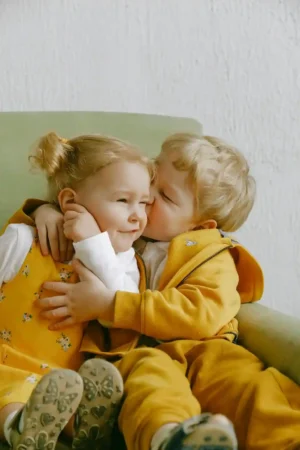
There are days when having more than one child feels magical.
They’re giggling together on the couch.
They’re building a block tower as a team.
You sneak a photo and think, “Yes. This is what I dreamed of.”
And then… it all flips.
“He took my toy !”
“She’s looking at me !”
“That’s not fair !”
Someone screams. Someone shoves. And Someone cries.
You’re in the kitchen trying to make dinner, suddenly promoted to Judge, Referee, and Chief Peace Officer, wondering :
- Why are they always fighting ?
- Did I do something wrong ?
- Are they going to hate each other forever ?
I’ve been there, too.
Sibling Rivalry can make even the calmest mom feel defeated. You want your kids to be close. You want your home to feel peaceful. And instead, you’re breaking up the third fight before 9 a.m.
Here’s the reassuring part: conflict between siblings is normal. It doesn’t automatically mean they have a “bad relationship” or that you’re failing as a parent. In fact, how you handle these moments can actually teach them important skills—like problem-solving, empathy, and self-control—that they’ll use for the rest of their lives.
In this post, we’ll talk about what’s going on underneath Sibling Rivalry and walk through practical, realistic ways to :
- lower the tension
- help your kids feel seen and valued
- and turn daily fights into opportunities to learn (most of the time 😉).
In this article : [+]
1. Understand What’s Behind Sibling Rivalry
It’s easy to see fights as “bad behavior,” but there’s usually a lot going on under the surface.
Common reasons siblings clash
- Competition for attention
Kids are wired to want their parents’ time and affection. When there are siblings, it can feel like they’re constantly checking : “Do I still matter as much?” - Different personalities and ages
One is loud and impulsive, the other is sensitive and slow-to-warm-up. One is a toddler, the other is eight. Their needs and abilities don’t always line up, which creates friction. - Big feelings they don’t know how to express
Jealousy, frustration, feeling left out, tiredness, hunger—siblings often take these feelings out on each other because you feel too important to “risk.” - Learning boundaries and power
Siblings are often kids’ first practice ground for learning what’s okay and what’s too far in relationships.
Pediatric and child-development experts say that sibling conflict is a normal part of development and can actually help kids learn social and emotional skills—as long as it happens in a home where safety, respect, and repair are present.
You’re not trying to eliminate every disagreement. You’re trying to guide them through those disagreements in a healthier way.
2. Give Each Child “Their Own Mom Time”
It sounds so simple, but one of the most powerful ways to reduce rivalry is also one of the hardest when you’re busy: one-on-one time.
When kids feel seen and valued as individuals, they don’t have to fight as hard for attention.
How to make it doable
This does not need to be a full “Mommy & Me Spa Day.” Think small and consistent:
- 10 minutes of reading alone with one child before bed
- a quick card game with your older child while the younger ones color
- letting one child help you cook while the others watch a show
- a short walk around the block with just one kid
During that time :
- put your phone away
- say things like, “I really like spending time with just you”
- follow their lead whenever possible
You’re sending a clear message :
“You are special. You don’t have to compete to be seen.”
Even a few minutes regularly can make a big difference in how much your kids feel the need to “prove” themselves against each other.
3. Stop Comparing (Even the “Nice” Comparisons)
We’ve all done it without thinking :
- “Look how nicely your sister is sitting. Can you sit like that?”
- “He always finishes his homework so quickly, why can’t you?”
Even positive labels can be tricky :
- “She’s the sporty one.”
- “He’s the smart one.”
- “She’s the calm one.”
These comments might sound harmless, but they can fuel Sibling Rivalry by :
- making kids feel like they’re in competition
- pressuring them to “stay in their lane”
- creating resentment (toward the sibling and toward you)
What to do instead
Focus on each child’s own growth and effort, not how they stack up against their sibling :
- “I noticed you kept trying, even when the puzzle was hard.”
- “You were really gentle with your little brother just now.”
- “You worked so hard on that drawing.”
If you catch yourself comparing, you can gently correct it :
- “Oops, I don’t want to compare you. You both have your own awesome things. I love how you did this today.”
You’re planting the idea that there’s room for everyone to shine in their own way.
4. Set Clear, Family-Wide Rules for Respect
Sometimes kids genuinely don’t know where the line is—especially if different things are allowed on different days depending on everyone’s mood.
Having simple family rules helps create a sense of fairness and predictability.
Keep the rules short and clear
You might have rules like :
- “No hitting or hurting bodies.”
- “We use kind words (no name-calling).”
- “We take turns with shared toys.”
- “We ask before borrowing someone else’s things.”
Involve your kids in creating the rules if they’re old enough. Ask :
“What rules would help our family be kind and safe?”
Write them down and post them somewhere visible (fridge, hallway).
Then, when conflict happens, you can calmly say :
- “Remember our family rule—no hurting bodies.”
- “Our rule is to ask before taking. Let’s try that again.”
This reduces the feeling that you’re “taking sides” and shifts it to :
“We’re all held by the same rules.”
5. Stay Neutral When You Can (Even When You Think You Know Who Started It)
This one is hard—especially when one child seems to always be the “instigator.”
But if you constantly jump in as judge and declare one “guilty” and one “innocent,” kids may start :
- playing the victim to get you on their side
- resenting each other more
- fighting harder because it “works” to get your attention
Acknowledge feelings without picking a favorite
When you walk into a conflict, try :
- “I hear a lot of yelling. It sounds like you’re both upset.”
- “I can see you’re mad, and you’re feeling sad. Let’s take turns telling me what happened.”
Give each child a short chance to talk without interruptions (even if their version isn’t totally “accurate”).
Then focus on solutions, not blame :
- “Okay, we have one toy and two kids. What are some ways we can solve this?”
- “You both wanted the same swing. Let’s make a plan so you each get a turn.”
You’re teaching them that their perspectives matter—but so does problem-solving.
6. Teach Problem-Solving Instead of Always Solving It for Them
Our instinct is often to jump in and fix it quickly :
- “Give it back to her.”
- “You had it first, so you get to keep it.”
Sometimes that’s necessary (especially for safety), but as they get older, it’s important to shift into coaching, not always controlling.
Simple problem-solving steps
You can guide them through a basic process :
- Pause and calm
- “Everyone take a breath. We’ll talk one at a time.”
- Each child shares
- “Tell me what you wanted.”
- Reflect and validate
- “You wanted the toy, and you wanted it too. That’s tough.”
- Brainstorm solutions together
- “How can we make this fair?”
- Take turns with a timer
- Play together
- Find a similar toy
- “How can we make this fair?”
- Agree and try
- “Okay, we’ll try this plan. If it doesn’t work, we’ll come back and try something else.”
Studies on social-emotional learning show that kids who practice these kinds of conflict resolution skills early on tend to do better with relationships and behavior later in life. You’re not just solving today’s fight—you’re teaching lifelong skills.
7. Encourage Teamwork and “Same Side” Moments
If the only time your kids are interacting is when they’re fighting over toys or space, it’s no wonder they see each other as rivals.
You can gently create moments where they feel like they’re on the same team.
Easy teamwork ideas
- Shared tasks
- “Can you two be my ‘clean-up crew’ and see how fast you can put the blocks away together?”
- “You hold the dustpan, you sweep!”
- Joint projects
- Building a pillow fort
- Baking cookies (one cracks eggs, one stirs)
- Creating a “show” to perform for the grown-ups
- “Us vs. chore” games
- “Let’s see if we can all beat the timer and get the living room clean in 5 minutes!”
And when they do work together, point it out :
- “I love how you two teamed up to build that tower.”
- “You really helped your brother when you found his missing piece. That was kind.”
You’re helping them build a shared identity :
“We’re siblings, and sometimes we fight—but we also help each other and have fun together.”
8. Protect Personal Space and Special Things
Constant sharing can make kids feel like they never truly own anything. That alone can increase Sibling Rivalry.
Create some “just mine” space
- Let each child have a few special items that do not have to be shared.
- Provide a shelf, bin, or drawer for their personal things.
- Teach siblings to ask before touching those special items.
For shared toys, you can explain :
“Some things in our home are for everyone to use. Some things are just for you. We always ask before using someone else’s special things.”
This can reduce fights because your kids feel more secure :
- “This is mine and safe.”
- “Those are shared and we take turns.”
9. Step In Firmly When There’s Aggression
Not all conflict is equal. Loud voices and “That’s not fair!” are different from hitting, biting, or bullying.
When things cross the line into unsafe territory, it’s important to step in right away.
What that can look like
- Move physically close, use a calm but firm voice :
- “I will not let you hurt your brother.”
- “Hands are not for hitting. I’m going to move you apart.”
- If needed, separate kids for a short cool-down :
- “You’re both too upset to solve this right now. We’re going to take a break and talk later.”
- Later, when everyone is calmer, you can :
- talk about what happened
- validate feelings
- review family rules
- practice better choices for next time
If aggression is frequent, intense, or scary, it can be helpful to talk with your pediatrician or a family therapist to get more tailored support. You don’t have to figure it all out alone.
10. Remember : Repair Is More Important Than Perfection
You will :
- lose your cool sometimes
- say the wrong thing
- accidentally take sides
- miss the beginning of a conflict and only hear the shouting
You’re human.
What matters more than getting it right every time is that you’re willing to repair—with your kids individually and together.
Simple repair ideas
- “I’m sorry I yelled earlier. I was feeling overwhelmed. Next time I’m going to try to take a breath before I talk.”
- “I think I might have blamed you without hearing the whole story. I’m sorry. I want to do better at listening to both of you.”
- “I love you both. We’re all learning how to share and solve problems together.”
This models for your kids :
- that relationships can survive conflict
- that apologizing is normal
- that grown-ups are still learning too
You’re giving them a blueprint for how to repair fights in their own lives one day.
Encouragement : You’re Not Raising Robots, You’re Raising Humans 💛
Mama, if your day has been filled with :
- “She took my stuff!”
- “He’s annoying!”
- “It’s not fair!”
…please know this: you are not alone, and this season does not last forever.
Some of the closest adult siblings I know grew up wrestling on the carpet, screaming about who got to sit in the front seat, and declaring “I’m never talking to you again!” at least once a week.
Your kids don’t need a rivalry-free childhood to love each other deeply. They need :
- a safe home where feelings are allowed
- clear limits around hurting and respect
- a parent who keeps showing up, even on the hard days
And that’s you.
You don’t have to fix every argument. You don’t have to referee every tiny squabble. Start with small shifts—more one-on-one time, fewer comparisons, simple family rules, and a little more problem-solving—and trust that those small seeds will grow.
You’re doing better than you think. Truly. 🌼
Let’s Be Honest—What’s the Hardest Part?
I’d love to hear from you :
👉 What’s the hardest part of Sibling Rivalry in your home—constant bickering, physical fights, jealousy, bedtime battles, something else?
Share your story or your favorite “it actually helped!” strategy in the comments—another mama might be reading and feeling exactly the same way right now. 💬
And if you’d like more gentle discipline tips, emotional skills support, and cozy encouragement in your inbox, make sure to join my email list. We’ll keep figuring out this whole sibling thing together, one messy, beautiful day at a time. 💌