
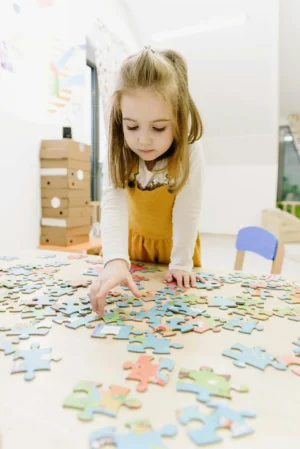
I still remember the first time I bought a “simple” 12-piece puzzle for my toddler.
In my mind, it was going to be this sweet, Instagram-worthy moment :
We’d sit together on the rug, talk about the colors, and proudly clap when the last piece clicked into place.
Reality ?
Pieces in the toy bin.
Pieces under the couch.
One piece firmly lodged in a tiny mouth.
Zero interest in actually doing the puzzle.
Meanwhile, I kept seeing advice everywhere about Puzzles and Games for Toddler and Preschool brain development and feeling like I was failing because my kid only wanted to bang puzzle pieces together like blocks.
If you’ve ever thought :
- “Am I picking the right puzzles ?”
- “Is this even helping their brain — or just making a mess ?”
- “How do I actually play with them without turning it into a fight ?”
…you are absolutely not alone, mama.
The good news ? You don’t need fancy, 100-piece Pinterest puzzles or a closet full of board games to help your child’s brain grow. With the right kind of puzzles, simple games, and a relaxed approach, you can sneak in problem-solving, focus, memory, and early math and language skills — all through everyday play.
Let’s walk through the best puzzle and game ideas for toddlers and preschoolers, how they help your child’s development, and how to keep play fun instead of stressful.
In this article : [+]
1. Why Puzzles and Games Matter So Much for Little Brains
Before we get into recommendations, it helps to know why puzzles and games are such a big deal.
When your child is working on a puzzle or playing a simple game, their brain is practicing things like:
- Problem-solving :
“Where does this piece go?” “How do I win this game?” - Spatial awareness :
Turning a puzzle piece to fit, building a tower that won’t fall, figuring out “under, over, next to.” - Fine motor skills :
Pinching, placing, turning, stacking — all those tiny hand muscles get a workout. - Focus and patience :
Staying with one activity, even when it’s not instantly easy. - Memory and planning :
Remembering where a picture card was, or thinking ahead in a simple game.
And maybe the most important part :
- Confidence :
That “I did it!” moment when the last piece goes in or they win a round with you cheering them on.
You don’t have to lecture your kid about “executive functioning skills” (thank goodness 😅). Just giving them age-appropriate puzzles and games — and a little space to try, fail, and try again — does so much of the work for you.
2. Best Puzzles for Toddlers (Ages 1–3)
For toddlers, the goal is success, not perfection. We want them to feel like, “Hey, I can do this!”
Here are great types of puzzles for this age :
2.1. Knob Puzzles
These are the chunky wooden puzzles with big knobs on each piece.
Why they’re great :
- Easy to grab with tiny hands
- Simple pictures: animals, shapes, vehicles, fruits
- Perfect for matching and early vocabulary
How to play :
- Name each picture as they pick it up: “Cow. Moo!”
- Offer just 2–3 pieces at a time if the whole board feels overwhelming.
- Celebrate small wins: “You found where the cow goes! High five!”
2.2. Chunky Wooden Puzzles
These pieces are thick, can stand upright, and double as little toys.
Why they’re great :
- Work as both a puzzle and pretend-play figures
- Build hand strength and coordination
- Encourage language: “The fire truck goes to the house,” “The dinosaur is under the tree.”
Fun idea :
After finishing the puzzle, pretend each piece is a character. Make animal sounds, drive vehicles around, or build a tiny story together.
2.3. Simple Two- to Four-Piece Puzzles
When they’re ready, you can introduce very small, simple jigsaw-style puzzles (like a picture split into two or four big pieces).
Why they’re great :
- Introduce the idea of connecting shapes and edges
- Challenge their brain just enough without causing meltdown-level frustration
Tips :
- Start with puzzles where the picture is printed on the board beneath.
- Guide their hand at first: “Let’s turn it… now try again.”
- Use phrases like, “Let’s figure it out together,” instead of “No, that’s wrong.”
3. Best Puzzles for Preschoolers (Ages 3–5)
Preschoolers are ready for a bit more challenge and a lot more story.
3.1. 9–24 Piece Jigsaw Puzzles
Look for :
- Big pieces
- Clear, colorful pictures (animals, vehicles, favorite characters)
- Themes they’re obsessed with (dinosaurs, unicorns, construction, Paw Patrol…)
Skills they build :
- Planning (“Let’s find all the edge pieces first.”)
- Visual scanning
- Persistence — sticking with a task longer
How to support without taking over :
- Sort pieces together: “Let’s put all the sky pieces here.”
- Offer hints instead of answers: “What do you notice about this piece? Is it more blue or more green?”
- Let them place the last piece — kids love that feeling of finishing.
3.2. Alphabet, Number, and Shape Puzzles
These “learning” puzzles can be wonderful as long as they stay playful.
Look for :
- Alphabet puzzles where each letter corresponds to a picture (A–apple, B–ball)
- Number puzzles with dots, animals, or objects to count
- Shape puzzles that move beyond basic circles and squares (hexagons, ovals, etc.)
How to keep them fun, not school-ish :
- Play “letter treasure hunt”: “Can you find the letter that starts your name?”
- Do quick counting races: “Let’s count the apples together before we put the piece in.”
- Let them lead. If they just want to dump and refill the tray, that’s still learning.
4. Simple Games That Build Brain Power
You don’t need complex board games. Toddlers and preschoolers learn so much from the simplest games.
4.1. Matching and Memory Games
You can buy matching cards or make your own by drawing simple pictures on index cards.
Why they’re amazing :
- Strengthen memory
- Build focus and attention
- Teach turn-taking when you play together
How to simplify for younger kids :
- Start with just 3–4 pairs instead of the whole deck.
- Play face-up matching first (“Can you find another dog like this one?”).
- Move to face-down “memory” style when they’re ready.
4.2. “I Spy” Games
You can play I Spy anywhere: in the car, at the doctor’s office, or while they’re eating a snack.
Skills it supports :
- Vocabulary
- Observation
- Attention to detail
Examples :
- “I spy something red.”
- “I spy something that starts with the sound /b/.”
- “I spy something you can wear.”
Let your child take a turn being the “spy” too.
4.3. Movement Games (Still Count as Brain Games!)
Games like :
- Simon Says
- Red Light, Green Light
- Freeze Dance
These help with :
- Following directions
- Self-control (“Oops, Simon didn’t say!”)
- Listening skills
It looks like pure chaos, but their brain is working hard to listen, stop, think, and act.
5. Building Toys That Work Like Puzzles
Many of the best “puzzles” aren’t traditional puzzles at all — they’re open-ended building toys.
5.1. Blocks
Classic wooden blocks, foam blocks, or Duplo-style bricks all count.
What they build :
- Logic and cause-and-effect (“If I stack this too high, it falls.”)
- Spatial reasoning (towers, bridges, walls)
- Language skills as they narrate their buildings
Try :
- “Can you build something taller than your teddy?”
- “Let’s make a bridge and see which cars can go under it.”
5.2. Magnetic Tiles or Stackers
These grow beautifully with your child from toddlerhood into early school years.
Skills :
- Understanding shapes
- Early geometry (triangles, squares becoming 3D structures)
- Creativity and planning
You can build simple flat shapes with toddlers and later move into castles, rockets, and cities with preschoolers.
5.3. Simple Train Tracks and Roads
Building a continuous track or road that loops around is basically a puzzle challenge.
- Encourage them to problem-solve: “Hmm, the track doesn’t reach. What could we change?”
- Ask them to “fix” a gap or broken part of the track rather than jumping in immediately.
6. DIY Puzzles and Games with Everyday Objects
You absolutely do not have to buy everything you see recommended online. Your house is already full of learning tools.
Here are easy DIY ideas :
6.1. Lid Matching
- Save a few clean jars or containers and their lids.
- Mix them up and ask your child to “help the lids find their homes.”
Skills :
Matching, trial and error, fine motor, visual discrimination.
6.2. Sock Matching Game
- After laundry, pile up socks and turn it into a game :
“Can you find the sock that matches this one?”
Skills :
Visual scanning, categorizing, helping with chores (bonus!).
6.3. Tape Paths on the Floor
- Use painter’s tape to make a path or “road” on the floor.
- Have them drive cars, walk like a tightrope, or hop from one “island” to another.
Skills :
Balance, coordination, following paths — all puzzle-like thinking.
6.4. Homemade Puzzles from Pictures
- Print a photo (family, pet, favorite toy).
- Glue it to cardboard.
- Cut it into 2–6 big pieces.
Kids love puzzles featuring familiar faces and objects.
7. Choosing the Right Challenge : Not Too Easy, Not Too Hard
Think of puzzles and games like Goldilocks: you’re looking for “just right.”
Signs It’s Too Easy
- They finish in seconds with no effort
- They seem bored and move on quickly
Use these for “warm-up” or independent play, but introduce something a little more challenging for growth.
Signs It’s Too Hard
- Immediate frustration
- Throwing pieces
- Saying “I can’t!” or refusing to try
You can :
- Offer fewer pieces at a time
- Do the puzzle together with lots of support
- Save it for a few weeks and try again later
The sweet spot is where they need to think and try a bit — but can succeed with a little help or practice. That’s where their brain is doing the most growing.
8. How to Support Without Taking Over
This is hard for us as adults, especially when we can see the solution right there.
Here are gentle ways to help without stealing the “I did it!” moment :
8.1. Be Their Guide, Not the Fixer
Instead of putting the pieces in for them, try :
- “Where do you think this might go?”
- “Look, the edge is straight. Maybe it goes on the outside.”
- “What do you notice about the colors?”
You’re teaching them how to think, not just what to do.
8.2. Narrate Your Own Thinking
Say your thoughts out loud as you help :
- “I’m looking for a piece with green and a straight edge.”
- “Hmm, that didn’t fit. Let’s turn it and try another way.”
This shows them that problem-solving is a process, not magic.
8.3. Praise Effort, Not Just Success
Instead of only celebrating the finished tower or completed puzzle, say things like:
- “You kept trying even when it was tricky.”
- “I noticed you tried a different piece when that one didn’t work.”
- “You worked so hard on that — I’m proud of you.”
This builds resilience and a love of challenge, not fear of “getting it wrong.”
9. A Quick Expert-Style Perspective (In Mom Language)
Child development experts often highlight puzzles and games as powerful tools for early learning because they combine :
- Hands-on exploration (which little brains crave),
- Repetition (which strengthens brain connections), and
- Joy and playfulness (which make kids want to keep practicing).
You don’t have to follow a strict curriculum. Simply offering age-appropriate puzzles and simple games — and making them part of your normal week — sets a strong foundation for later skills in math, reading, and even emotional regulation.
Think of it this way : every time your toddler sticks with a tricky puzzle or game, they’re silently practicing :
“When something is hard, I can keep going, try a new way, and figure it out.”
That belief is worth more than any worksheet.
10. Encouragement for Tired, Busy Moms
Mama, if your idea of a “brain-building activity” right now is letting your toddler dump puzzle pieces while you drink a hot coffee for 3 minutes — that still counts.
You don’t have to :
- Buy every educational toy
- Turn every playtime into a lesson
- Have your child loving puzzles today
Small things add up :
- One matching game before bed
- Five minutes of working on a puzzle together on a rainy afternoon
- A quick round of Simon Says while dinner cooks
All of that is helping your child build focus, confidence, and problem-solving — just through everyday play. You’re doing so much more than you realize. 💛
Share Your Favorite Puzzle or Game
I’d love to hear from you!
- What are your child’s favorite puzzles and games for toddler and preschool age?
- Do they love matching games, chunky puzzles, memory cards, or building blocks?
- Or do you have a funny puzzle disaster story like mine? 😅
Share in the comments — your idea might inspire another tired mama looking for something simple but meaningful to try this week.
And if you want more gentle, play-based ideas for boosting your child’s development, don’t forget to join my email list so we can tackle this beautiful, messy mom-life together. 💌