
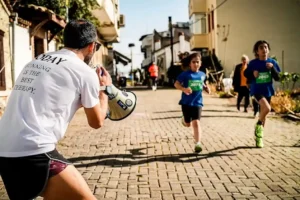
I remember the first time I really started thinking about Encouraging a Child to Be Physically Active. We were at the park with friends, and all the kids were racing to the top of the climbing structure, zooming down the slide, and chasing each other in a blur of giggles and grass stains.
My child ?
Standing next to me, holding my hand. Watching.
Every time I gently asked, “Do you want to try the slide?” I got the same quiet answer:
“No… I’m scared.”
Meanwhile, another mom casually mentioned that her child was already in soccer and gymnastics, and my brain went into overthinking mode:
- “Am I not pushing enough ?”
- “Is something wrong ?”
- “How do I help without forcing ?”
If you’ve ever stood on the sidelines feeling torn between wanting to protect your cautious child and wanting them to enjoy being active, you’re not alone. I’ve been there too.
The good news? You absolutely can help your child move more, build confidence, and even fall in love with physical activity—without shaming, forcing, or turning it into a battle. In this post, we’ll talk about why some kids are cautious, simple ways to make movement feel fun (not scary), and how to support them step by step, at their pace.
Deep breath, mama. Let’s do this together. 💛
In this article : [+]
1. Start by Understanding Their Caution (Not Fixing It)
Before we sign them up for three sports and a ninja class, it really helps to pause and find out why your child is hesitant.
Some cautious kids might be afraid of :
- Getting hurt
- Looking “silly” in front of others
- Not being as fast or strong as other kids
- Trying something new without knowing exactly what will happen
Instead of “Come on, it’s not scary,” try :
- “I can see this feels a little scary for you.”
- “Can you tell me what part feels the scariest?”
- “Thank you for telling me how you feel. Let’s see how we can make it feel safer.”
You’re showing them: Your feelings are valid, and I’m on your team.
If your child’s fear is really intense, or they seem anxious in many situations (not just physical ones), it might be worth bringing up with their pediatrician or a child therapist who understands anxiety. That’s not a failure—it’s support.
2. Focus on Fun, Not Performance or “Being Sporty”
Many cautious kids shut down when they feel like something is a test :
- “Let’s see how fast you can run.”
- “Try to be as good as your cousin.”
- “You need to practice so you’re not the worst on the team.”
Instead, shift the focus from performance to pleasure.
Try :
- “Let’s play a silly jumping game together.”
- “Want to be animals and stomp like dinosaurs?”
- “Let’s see how many leaves we can stomp on!”
The goal is to help your child connect movement = fun + connection, not movement = pressure + judgment.
Health experts remind us that physical activity doesn’t have to be organized sports; active play counts too. Young kids, especially preschoolers, benefit from being active throughout the day in short bursts of play—running, climbing, jumping, and dancing.
So yes, running around the yard pretending to be dragons does “count.”
3. Let Them Help Choose the Activity
Many cautious kids feel much safer when they have some control.
Instead of deciding everything for them, give 2–3 simple, active options :
- “Do you want to ride your scooter or go for a nature walk?”
- “Should we do a dance party or a balloon game?”
- “Would you rather try swimming lessons or a kids’ yoga class?”
You’re still guiding things toward movement, but you’re letting them pick their version of it.
You can also tie activity to interests they already love :
- Nature-loving kid → scavenger hunt at the park
- Music-loving kid → dance party, freeze dance, or kids’ Zumba videos
- Animal-obsessed kid → animal walks (bear crawl, frog jumps, flamingo balance)
Movement feels less scary when it’s wrapped in something familiar and fun.
Real-life example :
My child was not interested in “practice running,” but when I said, “Let’s run like cheetahs to see if we can catch that pretend gazelle (aka Daddy),” suddenly we had a full-on sprint in the backyard.
4. Start Small (Like, Really Small) and Build Up Slowly
For cautious kids, “Let’s go to soccer practice for an hour” can feel like jumping into the deep end.
Instead, think baby steps :
- 5 minutes of dancing in the living room
- One slide at the park with you holding their hand
- A short walk to the end of the street and back
- Practicing one skill at home (like throwing a ball) before joining a class
As their confidence grows, you can gently increase :
- Time (from 5 minutes to 10, then 15…)
- Difficulty (from flat grass to a small hill, from walking to light jogging)
- Independence (from holding your hand to doing it side by side, then watching from a distance)
Experts recommend that preschool-aged children be active throughout the day and that older kids (6 and up) get around 60 minutes of moderate-to-vigorous activity daily. But that doesn’t mean it all has to happen at once—it can be lots of little bursts.
Mom moment :
There was a season when I counted “let’s race to the mailbox” as a big win. It wasn’t a full workout—but it was movement, and more importantly, it was progress.
5. Be the Role Model (Even If You Don’t Feel “Sporty”)
You don’t have to be a marathon runner or gym person to model an active lifestyle. Your child mostly needs to see that moving your body is normal and enjoyable.
Try sprinkling phrases into everyday life like :
- “A walk always helps me shake off my grumpy mood.”
- “I love how strong my legs feel when we climb this hill together.”
- “Let’s stretch our bodies; it feels so good after sitting.”
Research shows that regular physical activity in childhood helps with brain health, school performance, heart and lung health, bone strength, and maintaining a healthy weight. Kids are much more likely to move regularly when they see their parents and caregivers doing it, too.
This doesn’t have to be fancy. It might look like :
- A quick family walk after dinner
- Doing a few silly stretches together before bed
- Playing “chase” in the yard
- Joining them on the playground instead of only sitting on the bench
And yes, “I’m tired, but I’ll do a few laps with you” absolutely qualifies as hero-level parenting.
6. Make It a Family Thing, Not a Spotlight on Your Child
Some kids feel super self-conscious when all eyes are on them: “Run! Jump! Show us!”
To reduce the pressure, turn activity into family time instead of a solo performance.
Ideas :
- Family walk or bike ride : Everyone goes, at the slowest person’s pace.
- Backyard games : Balloon volleyball, tag, obstacle courses where you also crawl under the chairs.
- Weekend “movement tradition” : Saturday morning park time, Sunday evening dance party, or “Friday night flashlight walk” around the block.
This helps your child feel like :
“We’re doing this together,”
not
“Everyone is watching to see if I’m brave enough.”
Plus, shared active time can be a big mental health boost for everyone—kids and adults. Regular activity has been linked to better mood and lower risks of anxiety and depression in children and teens.
7. Practice New Skills Privately Before “Big” Settings
If your child freezes in group settings (gym class, sports teams, crowded playgrounds), you can gently build their confidence at home first.
For example, before signing up for :
- Soccer → practice kicking, stopping, and dribbling a ball in the yard.
- Swimming → get comfy splashing in the bathtub or a small pool, blowing bubbles in the water.
- Dance class → try simple routines from kids’ dance videos at home.
The idea is to help your child feel :
“I kind of know what I’m doing,”
instead of
“Everyone will see that I have no clue.”
Mom example :
Before we joined a little kids’ gymnastics class, we practiced very simple things at home: rolling like a log on the floor, walking on a line of tape, and doing “star jumps.” By the time we showed up, my child saw familiar movements and looked at me like, “Oh, I already know this!”
8. Praise Effort, Courage, and Tiny Wins (Not Just “Success”)
For cautious kids, the bravest part is often just trying.
Instead of only cheering when they do something “big” (like finally jumping off the step), try to notice and celebrate :
- Taking one extra step
- Touching the ladder even if they don’t climb
- Watching other kids more closely and then taking a small turn
You might say :
- “I saw you climb two steps today—that took a lot of courage.”
- “You tried something new, even though you were nervous. I’m really proud of you.”
- “You listened to your body and took a break. That’s smart.”
Praise like this helps your child connect activity with confidence and growth, not just being “good at sports.”
9. Gently Balance Screen Time and Active Time
Screens are part of modern life—no shame or guilt here. But it’s easy for quiet screen time to quietly replace active play time if we’re not intentional.
Organizations like the American Academy of Pediatrics suggest using a Family Media Use Plan to create healthy boundaries, like screen-free zones (dinner table, bedrooms) and screen-free times (before bed, during family activities).
Simple ideas :
- “Screens off after dinner; then we do a 10-minute walk or dance party.”
- “No tablets at the park—today is for climbing and running.”
- “One show, then we go outside for a bit.”
The goal isn’t perfection—it’s balance. Even small swaps add up, like :
- 10 minutes less scrolling → 10 minutes more sidewalk chalk, scooter time, or backyard exploring.
10. Know When to Ask for Extra Help (No Shame, Only Support)
Sometimes, even with all the encouragement in the world, something still feels “off” to you—and that’s worth paying attention to.
Consider talking with your child’s pediatrician if :
- They rarely want to move or play actively at all.
- They seem very uncoordinated or tired compared to peers.
- Their fear around movement or leaving the house is intense and constant.
- They avoid all physical activities, even gentle ones, or get extremely distressed.
Your doctor might :
- Reassure you that what you’re seeing is still within the range of normal
- Suggest simple strategies or resources
- Refer you to a physical therapist, occupational therapist, or child mental health specialist if needed
Early support—whether physical therapy, anxiety support, or just some extra guidance—can make a huge difference in helping kids feel more comfortable in their bodies and more confident trying new things.
You are not “creating a problem” by asking for help. You’re advocating for your child—and that’s powerful, loving parenting.
You’re Doing Better Than You Think (Encouragement & Support)
Mama, if you’re reading this because you worry your child “isn’t active enough” or you feel torn between protecting them and pushing them—you’re already doing so much more than you realize.
You’re paying attention.
You’re asking questions.
You’re looking for gentle ways to support them—not shame them.
Remember :
- Not every child will love team sports. That’s okay.
- Moving their body through walks, play, dancing, climbing, and exploring still counts.
- Progress can look quiet and slow: one extra step, one new game, one more minute outside.
Small, consistent nudges—wrapped in love, play, and patience—can add up to a lifetime of feeling safer and happier being active.
You and your cautious kid are a team. And teams get stronger over time. 💛
Let’s Chat, Mama
I’d love to hear from you :
👉 Do you have a cautious child? What has helped them feel more confident moving their body?
Share your story or your favorite low-pressure activity in the comments—another mama might really need your idea today.
If this post on Encouraging a Child to Be Physically Active made you feel a little more hopeful and a little less alone, feel free to share it with a friend or save it for later.
And if you’d like more cozy, judgment-free tips on child development, routines, and mom life, you’re always welcome to join my email list for weekly encouragement and simple, real-life ideas. 💌