
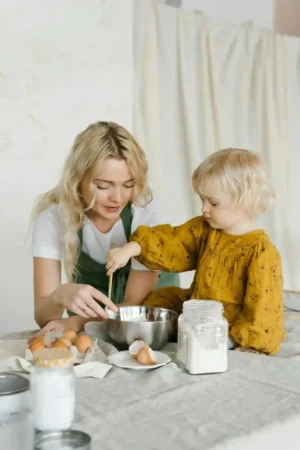
I didn’t even know what Household Fine Motor Activities were the first time my toddler turned our kitchen into a tiny occupational therapy gym.
I was standing at the counter, trying to make dinner, when I noticed she had quietly opened the “random stuff” drawer—you know, the one with rubber bands, chip clips, measuring spoons, and that one mystery key.
Instead of making a mess (okay, there was some mess), she was completely focused:
Clipping chip clips onto the edge of a dish towel.
Pulling them off.
Lining up measuring spoons.
Fiddling with a jar lid like it was the most interesting puzzle in the world.
My first thought was, “Wow, she’s busy.”
My second was, “Wait… this is actually good for her hands.”
If you’ve ever felt guilty for not buying all the fancy Montessori trays and fine motor toys, please hear me: you probably already own a goldmine of fine motor tools. They’re just hiding in your kitchen, office drawer, and laundry basket.
In this post, we’ll walk through easy, low-prep Household Fine Motor Activities that use things you already have at home. These little games help build the small muscles in your child’s hands, fingers, and wrists—the ones they need for everyday tasks like writing, dressing, eating, and more.
No Pinterest perfection. No expensive supplies. Just real-life mom hacks that work.
In this article : [+]
1. Why Fine Motor Skills Matter (And Why Your House Is Enough)
Fine motor skills are the small, precise movements that use the muscles in the hands, fingers, and wrists—often together with the eyes. Your child uses these skills to :
- Hold a spoon or fork
- Button a shirt or zip a jacket
- Stack blocks and build with small toys
- Use scissors, crayons, and pencils
- Open snack containers and lunch boxes
Experts explain that fine motor skills are key for independence in daily tasks like dressing, eating, and writing. Occupational therapists often use simple, everyday activities—like cutting, stringing beads, or picking up small objects—to strengthen those little muscles and improve coordination.
The best part? You can support this at home without turning your living room into a classroom. Ordinary objects—tongs, containers, pasta, stickers, clothespins—can become powerful tools for fine motor play.
Safety note : Always supervise closely, especially with small objects (choking risk), scissors, and anything that could break. These ideas are for you to adapt based on your child’s age and safety needs.
Ready to shop your own house? Let’s go room by room.
2. Tongs, Tweezers, and “Rescue Missions” (Kitchen Drawer Fun)
What you need :
Tongs, tweezers, chopsticks, or small serving tongs; plus small items like cotton balls, pom-poms, dry pasta, or crumpled paper.
How to play :
- Put a handful of small items in a bowl or on a tray.
- Give your child tongs or tweezers and something to transfer into:
- Muffin tin
- Empty egg carton
- Ice cube tray
- Turn it into a game:
- “Rescue the marshmallows from the ‘lava’!”
- “Feed the cotton balls to the hungry muffin monsters.”
Why it helps :
- Builds hand strength and the pincer grasp (using thumb and finger together).
- Works on hand–eye coordination and focus.
- Prepares little hands for pencil grasp and cutting later.
Mom moment :
This was one of my favorite “busy toddler while I cook” activities. I’d put her at the table with a muffin pan and some dry beans, and she felt like she was “helping” in the kitchen instead of just being told to wait.
3. Scooping, Pouring, and Kitchen “Science” Stations
What you need :
Measuring cups, spoons, funnels, bowls, and something to scoop—dry rice, lentils, beans, pasta, or water (if you’re feeling brave).
How to play :
- Set up a simple “sensory station” in a large bin or baking tray.
- Show your child how to :
- Scoop and pour from one container to another
- Fill and dump measuring cups
- Pour through a funnel
You can call it a “cooking experiment” or “magic potion lab.”
Why it helps :
- Strengthens wrist and hand muscles.
- Builds coordination as they aim and pour.
- Introduces early math concepts (full/empty, more/less) as a bonus.
Mess tip :
Put a towel or plastic tablecloth under everything. Tell yourself: “The clean-up is part of the activity.” Deep breaths. You’ve got this.
4. Sponge Squeezes and Water Transfers
What you need :
Two bowls, a sponge, and water.
How to play :
- Fill one bowl with water and leave the other empty.
- Show your child how to :
- Dip the sponge in water
- Squeeze it out into the empty bowl
- Repeat until most of the water has moved from one bowl to the other.
You can time it or make it a challenge : “Can you move all the water before I finish this song?”
Why it helps :
- Builds hand and finger strength (all that squeezing!).
- Great for early hand endurance (important for future writing).
- It’s calming and rhythmic for many kids—kind of like a mini water workout.
Mom note :
This one saved me on hot days when we couldn’t go anywhere. My child felt like she was doing “important work,” and I got five whole minutes to sip coffee while supervising. Win-win.
5. Lid Lab : Opening, Closing, and Twisting Jars
What you need :
A small collection of empty, clean containers: spice jars, yogurt tubs, plastic food containers, condiment bottles, etc.
How to play :
- Gather containers with different closures :
- Screw-on lids
- Snap-on lids
- Flip tops
- Zipper bags
- Put small safe items (pom-poms, cotton balls, big pasta) inside a few.
- Let your child practice :
- Opening to “discover” the items
- Closing them again
- Matching lids to the correct container
Why it helps :
- Practices wrist rotation, finger strength, and coordination.
- Builds skills needed for real-life tasks like opening lunch boxes and water bottles.
Safety tip :
Avoid glass and anything with sharp edges. Make sure lids are too large to be swallowed.
Mom moment :
I used to feel guilty handing my kid “trash” to play with. Then I realized—this is literally the kind of activity occupational therapists recommend: real-world fine motor practice with simple objects. Suddenly my recycling bin felt like a treasure box.
6. Sticker Station, Hole Punch Party, and Rubber Band Play
Now we move to the office drawer and craft box.
Sticker Station
What you need :
Sticker sheets and paper (or a notebook).
How to play :
- Have your child peel stickers off the sheet and place them on paper.
- You can draw simple shapes and have them decorate inside the lines.
Why it helps :
- Peeling requires using the tips of the fingers—great for the pincer grasp.
- Placing stickers builds hand–eye coordination.
Hole Punch Party
What you need :
Single-hole punch and scrap paper.
How to play :
- Show your child how to squeeze the puncher to make holes.
- Collect the little circles as “confetti” for crafts.
Why it helps :
- Strengthens the whole hand and fingers.
Rubber Band Stretching
What you need :
Rubber bands and a can, water bottle, or paper towel tube.
How to play :
- Have your child stretch rubber bands around the object.
- Make patterns or “rainbow stripes” with different colors.
Why it helps :
- Builds finger strength and dexterity.
Mom tip :
Keep a small “fine motor basket” with stickers, scrap paper, a hole punch, and a few rubber bands. It’s an easy grab-and-go activity for those “mama needs five minutes” moments.
7. Tear, Snip, and Dot : Paper Play and Q-Tip Painting
Paper tearing
- Give your child scrap paper, catalogs, or junk mail.
- Show them how to tear it into strips or tiny pieces.
This sounds too simple, but occupational therapists often recommend tearing and crumpling paper to build hand and finger strength.
Snipping with child-safe scissors
- Draw straight lines on paper and let your child snip along them.
- For beginners, just cutting fringe along the edge of a strip is plenty.
Q-tip (cotton swab) painting
- Give your child Q-tips, washable paint, and paper.
- Encourage them to :
- Make dots
- Trace over simple shapes or letters you draw
- Create patterns (dot–dot–dash, etc.)
Why it helps :
- Tearing and cutting build bilateral coordination (using both hands together).
- Q-tip painting encourages a more refined, pencil-like grip and controlled wrist/finger movement—great prep for handwriting.
Mom moment :
When we first tried scissors, I was nervous about fingers and hair. We started with playdough scissors and thick paper strips, with me sitting right next to her. Once she got the hang of it, she was so proud: “I cut it myself!”
8. Sorting, Organizing, and “Work” That Feels Like Play
Kids love feeling helpful. Use that to your advantage.
Sorting games
- Sort coins (for older kids), buttons, or large beads by:
- Color
- Size
- Type
- Use muffin tins, egg cartons, or small bowls as “sorting stations.”
Jewelry or treasure organizing
- Give them a small box of safe items (bracelets, big plastic rings, hair ties).
- Let them organize by type or color.
Why it helps :
- Picking up and placing small objects strengthens the small muscles of the hands.
- Sorting builds visual discrimination and early math skills.
Dressing practice
- Practice buttoning, snapping, and zipping with real clothes.
- Use a “buttoning shirt” you keep just for practice.
These everyday skills are fine motor and independence boosters.
Mom note :
There were days when “helping” fold laundry meant my toddler sat there putting socks into piles and pulling them apart. It slowed me down… but it was great for her fingers and made her feel included.
9. Playdough, Putty, and Card Games: Extra Hand Workouts
Playdough and putty
- Have your child roll “snakes,” pinch “cookies,” poke with fingers, and flatten “pancakes.”
- Add tools: plastic knives, cookie cutters, rolling pins.
Fine motor experts often recommend playdough because it strengthens the small muscles while staying playful and creative.
Card games
- Let your child help :
- Shuffle (their version of it)
- Deal cards
- Pick up and organize a hand of cards
This is surprisingly good finger work and hand–eye coordination.
Why it helps :
- Squeezing, rolling, and pinching dough = strength + coordination.St. Jude together+1
- Handling cards encourages precise finger movements and bilateral coordination.
Mom moment :
We used to “make pizza” with playdough: my child rolled out the dough, pinched the crust, and dotted on tiny pretend toppings. She thought she was playing restaurant; I knew her hands were getting a great workout.
10. What the Experts Say (Trust-Building, Without the Jargon)
A few simple takeaways from pediatric and therapy sources :
- Fine motor skills are essential for everyday independence—things like eating, dressing, and writing.
- These skills develop over time and can be supported through naturally occurring play and simple activities at home—you don’t need fancy materials.
- If you’re concerned that your child isn’t meeting fine motor milestones, experts recommend talking with your pediatrician and, if needed, an occupational therapist, who can provide targeted strategies.
In other words : your kitchen drawer + a little creativity can absolutely support healthy fine motor development—and professionals are there to help if you ever need more guidance.
You’re Doing Better Than You Think (Encouragement & Support)
Mama, if you’ve ever felt a pang of guilt because you don’t have the “right” toys or the Instagram-perfect activity setup, I hope this gives you a big, gentle exhale.
Every time you :
- Let your child help stir the muffin batter
- Hand them a sticker sheet while you answer an email
- Invite them to squeeze a sponge on the patio
- Ask them to help open containers or sort buttons
…you’re not “just keeping them busy.” You’re actively supporting their fine motor development and independence—using what you already have.
It doesn’t have to look pretty. It doesn’t have to be long or structured. Small, simple Household Fine Motor Activities sprinkled into your day really do add up.
You’re juggling a lot, and you’re still looking for ways to help your child grow. That alone says so much about the kind of mom you are. 💛
Let’s Share Ideas
I’d love to hear from you :
👉 What’s one simple fine motor activity your child loves using things you already have at home?
Share it in the comments—your idea might save another mama’s afternoon.
If you found these Household Fine Motor Activities helpful, feel free to save this post for later or share it with a friend who’s in the “busy little hands” season too.
And if you’d like more cozy, judgment-free tips on development, routines, and mom life, you’re always welcome to join my email list for weekly encouragement and real-life ideas you can actually use. 💌