
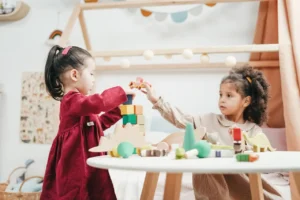
I still remember the first time I heard the phrase “Open-Ended Toys for toddler development.” I honestly rolled my eyes a little. And I pictured expensive wooden toys in a perfectly organized playroom that definitely did not look like my living room… which usually had socks, snack cups, and stuffed animals all over the floor.
But then I noticed something.
My toddler would ignore the flashy, noise-making toys after a few days… and spend forever playing with a cardboard box, a set of plastic cups, or a pile of blocks. She turned a scarf into a superhero cape, a river, a picnic blanket, and a magic cloud— all in one afternoon. That’s when it clicked: she didn’t need more entertainment. She needed more freedom to play.
That’s exactly what open-ended toys give our kids.
In this post, we’re going to talk about :
- What open-ended toys actually are (no, they don’t have to be fancy or expensive)
- Why they’re so powerful for your child’s brain, language, and creativity
- Specific toy ideas for ages 1–5 (with real-life, mom-tested examples)
- How to set up play so your child actually uses these toys
So grab your coffee (or reheat it for the third time, no judgment), and let’s make playtime simpler, calmer, and way more meaningful.
In this article : [+]
1. What Are Open-Ended Toys (and Why Do They Matter?)
Open-ended toys are toys that don’t have one “right” way to play with them.
There are no lights telling your toddler what to do, no music telling them they “won” or “lost.” Instead, your child decides how to use the toy, and the play can look completely different every time.
Think :
- A set of wooden blocks
- Magnetic tiles
- Play silks or scarves
- Animal figurines
- Playdough, crayons, and art supplies
These toys :
- Grow with your child from toddlerhood into preschool and beyond
- Support imagination, language, and problem-solving
- Encourage longer, deeper play (aka more time for you to drink your coffee hot 🙌)
When your toddler stacks blocks, knocks them down, and then builds a “castle” or a “garage,” they’re not just playing. They’re :
- Practicing fine motor skills
- Learning about balance and cause-and-effect
- Using language to describe what they’re building
- Gaining confidence : “I did it!”
Open-ended toys turn your child from a passive button-pusher into an active creator. That’s where the real magic (and growth) happens.
2. Building & Construction Toys (Perfect for Quiet, Focused Play)
If you only buy one type of open-ended toy, make it building and construction toys. They’re incredibly versatile and work for ages 1–5 and beyond.
Great options :
- Magnetic tiles (like Magna-Tiles or similar)
- Ages 1–2: Simple stacking, knocking down, and exploring colors and shapes.
- Ages 3–5: Building houses, rockets, cars, “castles,” zoos, you name it.
- Classic wooden blocks
- Chunky blocks are great for little hands.
- Kids can build towers, roads, walls, pens for animals, or entire “cities.”
- Duplo blocks
- Easier to grip than regular Legos.
- Toddlers love pushing them together and pulling them apart (hello, hand strength!).
- Preschoolers can build more complicated creations: farms, vehicles, robots.
Why these toys are amazing
- Encourage problem-solving :
“Why does this tower keep falling? What if I make the base wider?” - Build spatial awareness :
They’re quietly learning math and science concepts like height, balance, and symmetry. - Support perseverance :
The tower falls… and they try again. That’s resilience.
💡 Mom tip :
Set up a “building corner” with a small rug or mat and a basket of blocks or tiles. Sometimes just having a defined space invites your toddler to sit and build.
3. Imaginative Play : Kitchens, Figurines, and Play Silks
Toddlers LOVE copying us. (Except when we ask them to do something helpful, of course. 😅)
Open-ended pretend play toys let them act out real life and big feelings in a safe, playful way.
Favorite open-ended pretend play toys :
- Play kitchen & play food
- Toddlers: stir, pour, “feed” a doll or you
- Preschoolers: run a “restaurant,” bake birthday cakes, make potions
- Animal figurines and small people figures
- Farm animals, dinosaurs, people figures, cars and trucks
- These become characters in endless stories and adventures.
- Play silks or scarves
- They can be:
- Capes
- Blankets
- Rivers
- Picnic mats
- “Grass” or “fire” in small world play
- They can be:
Why pretend play matters
- Builds language :
They narrate: “The mommy cow is looking for her baby,” “The doctor is helping,” etc. - Processes emotions and daily life :
You may hear them playing “doctor,” “going to daycare,” or “bedtime” – all ways to work through their experiences. - Teaches social skills :
Taking turns, negotiating (“You be the dragon, I’ll be the knight”), solving problems together.
💡 Mom tip :
Keep a small basket of animal figurines or people in the living room. They pair beautifully with blocks and magnetic tiles for small world scenes.
4. Sensory & Active Play : Let Them Move and Explore
Toddlers learn with their whole bodies. Sensory and movement-based open-ended toys help them explore, calm their nervous systems, and build physical confidence.
Simple open-ended sensory & active toys :
- Balance boards
- Rocking, sliding cars down, using it as a bridge or tunnel in an obstacle course.
- Bilibo (that funny shell-shaped seat)
- It can be a seat, a boat, a helmet, a spinning top, a bucket, or part of a “mountain.”
- Tunnels and pillows
- Crawl-through tunnels, couch cushions, and pillows are amazing for DIY obstacle courses.
- Playdough / clay
- Squishing, rolling, cutting, poking with tools
- Great for fine motor skills and calming sensory input.
Why this matters for development
- Gross motor skills : Climbing, balancing, crawling, and jumping build strength and coordination.
- Body awareness : They learn where their body is in space (so important for safety and later skills like sports).
- Self-regulation : Sensory play can be incredibly calming for busy or anxious little ones.
💡 Mom tip :
On extra wiggly days, I set up a “path” around the room: balance board → tunnel → pillows → basket of blocks at the end. Suddenly my child has a game… and I have five minutes to breathe.
5. Art & Creativity Supplies : The Original Open-Ended Toys
Art supplies are some of the most powerful open-ended “toys” you can offer. They don’t need to be fancy.
Starter art kit for toddlers :
- Chunky crayons or washable markers
- Large sheets of paper or a roll of craft paper
- Non-toxic finger paints
- Stickers
- Playdough and a few simple tools (plastic knife, rolling pin, cookie cutters)
As they get older :
- Safety scissors
- Glue sticks
- Collage materials: scraps of paper, pom-poms, washi tape, etc.
Skills art play builds
- Fine motor skills : Gripping crayons, tearing paper, squeezing glue.
- Creativity & confidence : There’s no “right” answer; their ideas are valid.
- Focus : Many kids will spend a surprising amount of time absorbed in making something.
💡 Mom tip :
Keep art supplies in a small caddy or bin that you bring out to the table. It doesn’t need to be available 24/7 (unless you like crayon murals on the wall 😉).
6. How to Choose Open-Ended Toys (Without Overbuying)
It’s so easy to feel like you need all the trendy toys. You really don’t.
When you’re deciding what to bring into your home, ask yourself:
- Can this be used in more than one way ?
- A block can be a car, a phone, a bed for a doll.
- A toy laptop pretty much… just pretends to be a laptop.
- Will this still be interesting as my child grows ?
- Toddlers may just stack magnetic tiles; preschoolers will design castles.
- Open-ended toys have a really long “life” in your home.
- Does it require batteries to be fun ?
- Battery toys are not “bad,” but too many of them can turn the child into a passive observer.
- Open-ended toys let your child provide the sound effects and ideas.
- Is it safe, durable, and easy to clean ?
- Toddlers are not gentle. Solid construction matters.
💡 Budget tip :
Many open-ended toys can be thrifted or found secondhand. Also, don’t underestimate :
- Cardboard boxes
- Muffin tins
- Wooden spoons and plastic containers
- Old scarves (washed & safe, of course)
These can become excellent open-ended toys, especially for younger toddlers.
7. Setting Up a Play Space That Actually Works
You can have the best open-ended toys in the world, and they’ll still just sit there if your child feels overwhelmed or doesn’t know where to start.
A few simple tweaks can make a big difference:
1. Less is more
- Instead of a huge toy pile, put out a small selection:
- One set of blocks or tiles
- A few figurines
- A basket of scarves
- An art tray
Rotate toys every week or two. It keeps things fresh and reduces clutter.
2. Use baskets and trays
- Baskets make toys feel more inviting than big toy chests.
- A tray with a few animals + some blocks says “build a farm” without you saying a word.
3. Create “zones”
- A building zone (rug + blocks or tiles)
- A pretend play zone (kitchen, dolls, dress-up)
- A cozy corner with books and a few stuffed animals
- A table area for art and playdough
💡 Mom tip :
When things feel chaotic, I do a quick reset while my child is having a snack—put a small set of toys out intentionally. She almost always goes straight to something when she’s done eating.
8. Your Role in Open-Ended Play (Hint : You Don’t Have to Be “Fun Mom” 24/7)
Here’s the best part: you don’t have to entertain your child the whole time for open-ended play to work.
Think of yourself as :
- The guide who sets up the environment
- The support who joins in to kick things off
- The observer who steps back and lets your child lead
Try this :
- Sit with them for a few minutes and say something simple, like:
- “I wonder how tall we can build this tower.”
- “These animals need a home. Should we build them one?”
- Follow their lead as they change the story or build something new.
- Gradually pull back—maybe switch to quietly folding laundry while staying nearby.
You’re still present, still emotionally available, but you’re giving them space to explore and create on their own.
9. What Experts Say About Play and Open-Ended Toys
Child development experts and pediatric organizations consistently highlight play as essential—not optional—for healthy development.
In early childhood, the brain is forming an enormous number of connections. Open-ended, active play helps strengthen areas related to :
- Executive function – self-control, planning, flexible thinking
- Language and communication – talking, storytelling, negotiating
- Social skills – sharing, turn-taking, resolving conflicts
- Emotional regulation – processing big feelings through pretend scenarios
Many pediatric groups even describe play as a “fundamental building block” of learning and recommend protecting time for unstructured, child-led play in your child’s day—not just structured activities or screens.
So yes, when your toddler is happily building a tower, making a “soup” in their play kitchen, or drawing with crayons, they’re not “just playing.” Their brain is working incredibly hard in the best possible way.
10. “But My Toddler Just Throws Things…” (You’re Not Doing It Wrong)
If you’re thinking, “This all sounds great, but my toddler just dumps the blocks and walks away,” please know: you’re not alone.
Totally normal toddler behaviors :
- Dumping all the blocks and then leaving
- Throwing toys before they learn how to use them appropriately
- Playing with a new toy for three minutes and moving on
- Wanting you right there at first
Here are a few ways to handle it :
- Start small : Offer just a few blocks or tiles at a time instead of the full set.
- Model gently : “Blocks are for building, not throwing. If you want to throw, we can throw soft balls into this basket.”
- Invite, don’t force : You can start building something yourself and see if they wander over.
- Keep expectations realistic : Attention spans are short at this age. Even a few minutes of focused play is a win.
You’re planting seeds. Over time, your toddler will learn to explore more independently and use open-ended toys in more complex ways.
Encouragement for Tired Moms
Mama, if your brain feels full and your living room feels like a toy store exploded—take a deep breath.
You do not have to do this perfectly.
You don’t need :
- A Pinterest-perfect playroom
- Every “best” toy recommended on social media
- Hours of free time to orchestrate elaborate activities
What your child really needs is :
- A few simple, flexible toys
- Some space to play and imagine
- A parent who smiles at their creations and sits on the floor sometimes, not all the time
Small, consistent choices—like swapping one noisy, flashing gadget for a set of blocks or pulling out playdough instead of a screen—add up over time.
You’re already doing so much. Let play be something that supports both of you, not one more thing on your mental load.
You’ve got this. 💛
Let’s Chat, Mama – Your Turn 💬
I’d love to hear from you!
- What’s your toddler’s favorite open-ended toy right now?
- Are you team magnetic tiles, blocks, play kitchen, or cardboard box from your last delivery? 😄
Share it in the comments—your ideas might give another mama exactly the inspiration she needs today.
And if you’d like more cozy, real-life tips about toddler play, routines, and mom life, make sure to join my email list so we can hang out in your inbox, too.