
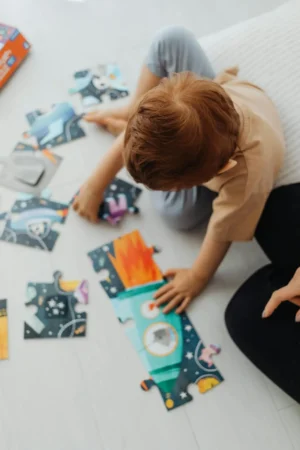
I still remember the first time my toddler tried to fit a square block into a round hole.
He pushed.
He turned it.
And he growled at it (very seriously).
Then he looked at me with those big, frustrated eyes as if to say, “Mama, fix it.”
Every part of me wanted to jump in and help. My brain was screaming, Just show him the right hole, it’ll be faster and there will be fewer tears. But a little voice inside whispered, This is it. This is what learning looks like.
If you’ve ever watched your child get frustrated because a toy won’t work, the puzzle piece won’t fit, or the tower keeps falling over, you’ve already seen the beginning of Problem-Solving Skills for toddler in action. It doesn’t look like a worksheet or a “smart” app. It looks like trying, failing, trying again… and slowly figuring things out.
In this post, we’ll talk about how everyday play builds your child’s problem-solving muscles, how you can gently support them (without turning into a full-time entertainer), and simple things you can do today—with what you already have at home. No pressure, no perfection, just real-life ideas from one tired-but-trying mom to another. 💛
In this article : [+]
What Do Problem-Solving Skills Look Like in Toddlers?
Before we dive into activities, let’s zoom out for a second.
Problem-solving for toddlers doesn’t look like “solving equations” or “thinking logically” in the grown-up way. It looks like :
- Figuring out how to stack blocks without the tower falling.
- Working out how to get a toy that rolled under the couch.
- Trying different ways to put on shoes or zip a coat.
- Negotiating with you for one more bedtime story (they’re much smarter than we think).
When your child is :
- Trying different ways to do something
- Asking “why ?” or “how ?”
- Getting stuck, frustrated, and then trying again
…they’re actually building problem-solving, persistence, and flexible thinking.
Your job isn’t to remove every challenge. It’s to create safe, supportive little “puzzles” in their day and walk alongside them as they figure things out.
Let’s talk about how to do that in simple, doable ways.
1. Let Everyday Play Do the Heavy Lifting
You don’t need fancy STEM toys to build problem-solving skills. Toddlers learn best through hands-on, unstructured play with everyday things.
Some powerful, simple play options :
- Blocks or stacking cups
- What they learn : balance, cause and effect, spatial awareness.
- Real-life problem-solving: “If I put the big block on top of the tiny one, it falls. What if I try it the other way around ?”
- Puzzles with chunky pieces
- What they learn : visual matching, trial and error, patience.
- Problem-solving : turning pieces, trying different spaces, noticing patterns.
- Cars, trains, or balls
- What they learn : cause and effect, predicting outcomes.
- Problem-solving : “Why did the car get stuck?” “What if I move the pillow?”
- Open-ended toys (like magnetic tiles, wooden blocks, dolls, or play food)
- What they learn : creativity, planning, making and testing ideas.
💬 Mama note :
Some of my favorite problem-solving moments happened when I just sat on the floor with my coffee and watched quietly. No big Pinterest setup—just my child, a bin of blocks, and time to explore.
2. Offer Just-Right Challenges (and Resist Rescuing Too Fast)
This is the hard one.
When our kids struggle, every instinct tells us to fix it. But a tiny bit of struggle—in a safe, supported way—is exactly where problem-solving grows.
Try this :
- Choose tasks that are a little challenging but not impossible, like :
- Putting blocks into matching holes
- Scooping and pouring without spilling everything
- Figuring out how to open a simple container
- When they get stuck, instead of jumping in and doing it :
- Pause. Breathe.
- Offer a gentle hint instead of a solution.
- Say things like :
- “Hmm, that piece is a bit big… what else could you try ?”
- “It fell down. What could we do differently ?”
- “Should we try turning it another way ?”
This teaches them :
- It’s okay to get stuck.
- We don’t give up right away.
- There are usually many ways to try something.
💬 Mama note :
I started telling myself, “If I can tolerate 10 extra seconds of whining, I might be giving 10 years of resilience.” It helped me stay calm and let my child push through the moment instead of fixing everything right away.
3. Use “I Wonder…” Questions Instead of Giving Answers
One of the easiest ways to build problem-solving skills for toddlers is by changing how we talk to them.
Instead of always giving instructions like :
- “Put that here.”
- “No, not like that.”
- “This is the right way.”
Try asking gentle questions that invite thinking :
- “I wonder where this piece could go ?”
- “What do you think would happen if we pour it in this bowl ?”
- “How could we make this tower stronger ?”
- “Hmm, the drawer won’t close… what’s in the way ?”
Why this works :
- It gives them space to think, not just follow.
- It shows them their ideas matter.
- It builds confidence: “I can figure things out.”
You don’t need to quiz them or expect “correct” answers. The goal is to spark curiosity, not test them.
💬 Real-life example :
At snack time, instead of just handing the plate, you might say :
“We have apple slices and crackers. How can we fit them both on the plate so they don’t fall off ?”
Suddenly, snack time becomes a little problem-solving moment.
4. Turn Chores and Routines Into Mini Problem-Solving Games
You’re already doing a million things a day. Good news : you don’t need extra activities—just turn what you’re already doing into brain-building moments.
Here are some ideas :
Getting dressed
- Ask : “Which shoe goes on which foot? How can we tell?”
- Let them try and figure it out (it’s okay if they get it wrong at first).
- Show them how to check : “See the curve here? It matches your foot.”
Cleaning up
- Turn it into a sorting game :
- “Cars go in this bin, blocks in that bin. Can you figure out where the teddy should go?”
- Ask: “What should we pick up first so we don’t trip?” (planning and prioritizing!)
In the kitchen
- Have them help set the table :
- “We need a plate, fork, and cup for each person. How many do we need?”
- Let them decide where things go :
- “Where should we put the napkins so everyone can reach?”
During bath time
- Offer cups, spoons, and containers :
- “What happens if we pour from the big cup to the small one?”
- “Which cup holds more water?”
💬 Mama note :
Some of the best “learning activities” happen when we’re running late, in pajamas, with toys all over the floor. That still counts. 😉
5. Use Toys and Household Items That Naturally Invite Problem-Solving
You don’t have to buy specific “problem-solving” toys, but some things are especially great for this age :
- Puzzles
- Start with chunky wooden puzzles, then move to 6–12 piece jigsaw puzzles.
- Let them try, rotate, and test pieces before you step in.
- Blocks, magnetic tiles, or Duplo
- Encourage simple challenges :
- “Can we build a bridge that the car can go under?”
- “Can you make a tower taller than your teddy?”
- Encourage simple challenges :
- Sorting and matching games
- Use : socks, lids, containers, spoons, buttons, pom-poms.
- Ask : “Can you match the lids to the right containers?” or “Can we sort these by color?”
- Loose parts play (safe items only!)
- Think : pinecones, bottle caps, fabric scraps, cardboard tubes.
- Let them create their own “machines,” food, roads, or patterns.
- Obstacle courses
- Pillows, blankets, couch cushions, and tape on the floor.
- Ask : “How can we get from the couch to the door without touching the floor?”
These kinds of activities let toddlers :
- Try new strategies
- Make mistakes safely
- See that their ideas can change the outcome
6. Practice Social Problem-Solving With Siblings and Friends
Problem-solving isn’t just about objects—it’s also about people.
Toddlers are still learning how to :
- Share
- Take turns
- Handle “That’s mine!” moments
- Ask for what they need
Instead of solving every conflict yourself, try coaching them through it :
- “You both want the red truck. What could we do?”
- “Should we take turns? Who could go first this time?”
- “If your friend is using it, what could you play with while you wait?”
You can also model simple scripts :
- “Can I have a turn when you’re done?”
- “I’m using this now. You can have it next.”
This helps toddlers learn :
- Negotiation
- Compromise
- Seeing someone else’s point of view
💬 Mama note :
No, they will not suddenly become angelic sharers. 😅 But over time, with repetition, they really do start using these phrases and ideas on their own.
7. Build Resilience : Praise Effort, Not Just Success
Problem-solving is not about getting the answer right the first time. It’s about :
- Trying
- Adjusting
- Trying again
So instead of only celebrating the “finished” tower or “perfect” puzzle, try praising the process :
- “I love how you kept trying even when it fell down.”
- “You tried three different ways to make that work—that’s amazing thinking.”
- “You figured out a new way all by yourself.”
This teaches your child that :
- Mistakes are normal
- Effort is valuable
- They’re capable of learning new things
Kids who feel safe making mistakes are more likely to :
- Take healthy risks
- Try new activities
- Think creatively instead of always looking for “the right answer”
8. Expert Insight : Why Play Is So Powerful for Problem-Solving ?
Child development experts talk a lot about play for a reason.
Research in early childhood development shows that :
- During the first years of life, the brain forms an incredible number of new connections.
- Hands-on, playful experiences help build pathways related to focus, memory, and flexible thinking (sometimes called “executive function skills”).
- Unstructured play—where the child chooses what and how to play—supports creativity, decision-making, and planning.
When your toddler :
- Experiments with water in cups
- Tries to figure out how a toy works
- Acts out stories with dolls or stuffed animals
…they’re not “just playing.” They’re practicing the same skills they’ll later use to :
- Solve math problems
- Work on group projects
- Handle challenges at school
- Navigate conflicts with friends
So when you feel guilty that you’re “just letting them play,” remind yourself: this is the work of childhood.
9. When to Trust the Process—and When to Check In With a Professional
Kids develop at their own pace, and some children are naturally more cautious or more curious than others. That’s okay.
You can usually relax if :
- Your toddler shows curiosity (exploring, poking, stacking, opening/closing things).
- They experiment in their own way, even if it looks messy or slow.
- They get frustrated but can eventually calm down with your support.
It can be helpful to talk to your pediatrician or an early childhood specialist if you notice:
- Very little interest in exploring toys or the environment
- Extreme frustration with any small challenge
- Frequent meltdowns whenever something doesn’t work right away
- Loss of skills they used to have (for example, they used to stack blocks or solve simple puzzles and suddenly stop)
Getting professional input doesn’t mean you’ve done anything wrong—it just gives you more tools and support.
10. Easy Ways to Add Problem-Solving to Your Day (Without Extra Prep)
If you’re thinking, “This all sounds great, but I’m exhausted,” I hear you. Let’s keep it simple.
Here are low-effort ways to build problem-solving into your day :
- Morning :
- Let your toddler choose between two outfits and figure out which way the shirt goes on.
- Ask them, “Where should we put your shoes so we can find them later?”
- Mealtime :
- Let them help set the table or decide where things go.
- Ask, “How can we fit everything on the tray so nothing spills?”
- Playtime :
- Offer blocks, containers, or a simple puzzle and sit nearby instead of leading every step.
- Say, “What could we try next?” instead of fixing it.
- Bath time :
- Give them cups, spoons, bowls—let them experiment with pouring and filling.
- Clean-up time :
- Turn it into a problem-solving mission: “How can we clean this up as fast as possible? Should we start with the biggest toys or the smallest?”
You don’t need a “perfect” activity plan. One tiny moment of curiosity, one extra “I wonder…” question, one time you wait 10 more seconds before stepping in—that’s enough to make a difference over time.
You’re Already Helping Your Toddler Become a Problem-Solver
Mama, if you’ve read this far, you’re already doing the most important thing: you care.
You’re paying attention. You’re wondering how to support your child’s mind and heart, not just keep them busy. That alone makes you an amazing parent.
Remember :
- You don’t need perfect activities.
- You don’t have to be “on” all day.
- You’re allowed to be tired and still be a good mom.
Every time you let your toddler try, wobble, spill, rebuild, and try again, you’re giving them a powerful gift: the belief that they can handle challenges. And that belief will follow them into school, friendships, and life.
Celebrate the small wins, laugh through the messes, and give yourself as much grace as you give your child. You’re both learning together. 💛
Let’s Share Ideas, Mama
I’d love to hear from you :
👉 What’s one simple way your child has surprised you with their problem-solving skills?
Did they stack toys in a new way, “fix” something you didn’t expect them to, or invent their own solution during play?
Share your story in the comments—your real-life example might inspire another tired mama who needs encouragement today. And if you found this helpful, feel free to share it or join my email list for more gentle, real-life tips for growing happy, curious kids.