
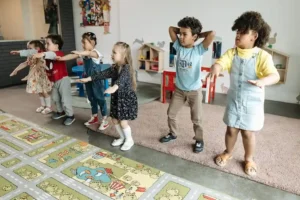
I still remember the first time I thought, “Okay, we seriously need some Social Skills Games for Toddlers and Preschoolers in this house.”
I’d set up what I thought was the perfect play moment :
- two kids
- one big bin of blocks
- snack bowls nearby
- coffee in my hand
What could go wrong, right ?
Within minutes, someone was yelling, someone was crying, and someone (fine, it was me) was wondering why sharing and taking turns seemed like an Olympic sport.
I used to think social skills were something kids just “picked up” as they got older, but the more I watched my toddler and preschooler navigate playdates, daycare, and siblings, the more I realized :
They don’t just need rules — they need practice.
That’s where play comes in.
The beautiful thing is that Social Skills Games for Toddlers and Preschoolers don’t have to be complicated or Pinterest-perfect. Simple, playful activities can quietly teach:
- turn-taking
- listening
- cooperation
- empathy
- handling winning and losing
…while your child just thinks you’re having fun together.
Let’s walk through some easy, low-prep games you can use at home, in the backyard, or even waiting at the doctor’s office to build real-life social skills—one giggle at a time. 💛
In this article : [+]
1. “Simon Says” – Listening and Self-Control in Disguise
Skill focus : Listening, impulse control, following directions
“Simon Says” is a classic for a reason. It looks like a silly movement game, but it’s doing a lot of quiet work in your child’s brain.
How to play
- Stand facing your child (or a small group).
- Give instructions starting with “Simon says…”
- “Simon says touch your toes.”
- “Simon says jump up and down.”
- “Simon says pat your head.”
- Every so often, give an instruction without saying “Simon says”:
- “Turn around.” (without “Simon says”)
Kids are supposed to only follow the directions that start with “Simon says.”
Why it works
To play, your child has to :
- stop and listen
- wait a second before acting
- control the urge to copy you every time
That’s self-regulation—one of the core social-emotional skills toddlers and preschoolers are still building.
Make it toddler-friendly
For little ones, don’t worry about “getting them out” if they move at the wrong time. You can just gently point it out :
- “Oops! Simon didn’t say that time. Let’s try again together.”
Your goal isn’t perfection; it’s practice.
2. “Red Light, Green Light” – Turn Waiting into a Game
Skill focus : Patience, following rules, body control
If your child struggles with waiting (so… basically every toddler), “Red Light, Green Light” is a fun way to practice.
How to play
- Stand on one side of the room or yard; your child stands on the other.
- Call out :
- “Green light!” – they run or walk toward you.
- “Red light!” – they freeze like a statue.
- If you want, add “Yellow light” for slow-motion walking.
Keep the energy light and silly. You can both take turns being the “traffic light,” which adds turn-taking and gives them a sense of power.
Why it works
Kids get to :
- practice stopping their bodies on cue
- listen carefully
- manage excitement and movement
All skills that help them in preschool—like lining up, waiting for a turn on the slide, or listening to the teacher.
3. Musical Chairs (or Musical Spots) – Handling Winning and Losing
Skill focus : Coping with disappointment, following directions, group play
Musical chairs can feel intense for very young kids, so I like to soften it into “musical spots” using pillows, towels, or even paper circles taped to the floor.
How to play
- Lay out a circle of “spots” (one for each child, or one fewer if kids can handle it).
- Play music (phone, clapping, humming—whatever you’ve got).
- Kids walk, dance, or march around.
- When the music stops, everyone finds a spot.
For toddlers, keep all the spots and let everyone “win” each round. For preschoolers, you can gently remove one spot at a time—if they’re ready.
Why it works
This game gives you a natural moment to practice :
- following group rules
- celebrating others
- handling not always getting what you want
You can model the language :
- “Aw, you didn’t get a spot this time. That feels disappointing.”
- “You can cheer for your friend. Your turn will come again next game.”
It’s a simple, playful way to introduce sportsmanship before they’re thrown into more competitive activities.
4. Emotion Charades – Learning to Read Feelings
Skill focus : Emotional awareness, empathy, nonverbal communication
Emotional skills are social skills. Kids who can recognize feelings in themselves and others are better able to share, take turns, and resolve conflicts.
How to play
Write or say simple emotions :
- happy
- sad
- angry
- scared
- excited
- surprised
Then :
- Take turns acting out a feeling without using words.
- The other person guesses: “Are you feeling… mad?”
You can add a second step :
“What might make someone feel that way?”
“I feel mad when someone takes my toy.”
Why it works
Kids :
- practice noticing facial expressions and body language
- build empathy by talking about why someone might feel that way
- learn that all feelings are okay—even the big, hard ones
You can do this on the couch, in the car, or even in line at the store. No supplies needed.
5. “I Spy” – Conversation and Describing Practice
Skill focus : Communication, attention, back-and-forth interaction
“I Spy” seems so simple, but it’s quietly building language and social skills.
How to play
Take turns choosing an object you can both see. Say :
- “I spy with my little eye… something red.”
- “I spy… something round.”
- “I spy… something that we eat.”
Let your toddler or preschooler guess until they find it. Then it’s their turn to pick something and give clues.
Why it works
To play, your child has to :
- pay attention to their surroundings
- think about what you can see
- describe something in a way that makes sense
That’s perspective-taking and communication—key parts of healthy friendships.
Plus, it’s perfect for :
- car rides
- waiting rooms
- restaurants
Instead of relying on screens, you’re building connection and skills through a simple game.
6. The Ball Toss Game – Simple Turn-Taking for Little Ones
Skill focus : Turn-taking, joint attention, early cooperation
For toddlers especially, social skills start with very basic interactions—like simply taking turns.
How to play
Sit on the floor facing your child. Roll or gently toss a ball back and forth:
- “My turn to roll.”
- “Your turn to roll.”
You can add siblings or another parent once your child gets the hang of it.
Why it works
This super-simple game helps your child :
- notice another person
- wait for their turn
- enjoy back-and-forth play
You can use anything : a soft ball, stuffed animal, even a crumpled sock in a pinch.
For many kids, this is the foundation that later becomes turn-taking with toys, games, and conversations.
7. Cooperative Board Games – Teamwork Instead of “I Win, You Lose”
Skill focus : Turn-taking, handling emotions, working as a team
For preschoolers, easy board games are a great way to practice social rules in a low-stakes setting.
To build social skills (without constant tears about who wins), look for cooperative games where everyone works together toward a shared goal.
Ideas (or similar types)
- Simple color-matching or path games
- “Feed the animals” style games
- Any game where players race together against a timer or task—not against each other
Why it works
Board games help kids practice :
- waiting for turns
- following rules
- staying in the game, even when it’s not their turn
- cheering for others
You can support by narrating out loud :
- “You really wanted to go first, but you waited. That was patient.”
- “We lost this time, but we worked together. Want to try again?”
Children’s mental health advocates often recommend board games as a playful way to teach social-emotional skills like patience, cooperation, and managing winning and losing.
8. Pretend Play Worlds – Practicing Real-Life Social Situations
Skill focus : Empathy, language, problem-solving, negotiation
Pretend play isn’t “just play.” It’s where kids try on roles, rewrite stories, and figure out how the social world works.
Easy scenarios to set up
You don’t need fancy toys—just a little imagination.
- Play “store”
- One child is the cashier, the other is the customer.
- Practice: “Hello,” “Please,” “Thank you,” “Have a nice day.”
- Play “doctor” or “vet”
- One child is the doctor, the other is the patient.
- Practice comforting words and asking questions.
- Play “restaurant”
- One is the server, one is the customer.
- Practice ordering, waiting, saying thanks.
Let your child lead, but sprinkle in phrases they can use in real life :
- “Can I play too?”
- “Do you want to share?”
- “Can I have a turn when you’re done?”
Why it works
Pretend play helps children :
- step into different perspectives
- rehearse social situations before they happen
- work through fears (“What if the doctor is scary?”)
You can also use puppets or stuffed animals if your child is shy—they often feel safer expressing themselves through a character.
9. Group Art and Building – Working Toward a Shared Goal
Skill focus : Collaboration, sharing space and materials, communicating ideas
Not every social skills game has to be competitive. Sometimes the best lessons come from working together on something.
Ideas to try
- Build one big tower or city with blocks or Magna-Tiles.
- Create a giant poster or collage together.
- Make a cardboard fort and decorate it.
As they work, you can gently support :
- “You both have ideas. Let’s see how we can use both of them.”
- “You want the blue block and so do you. How can we solve this?”
Why it works
Shared projects help kids learn to :
- negotiate and compromise
- respect each other’s ideas
- feel proud of something they built together
It quietly shifts the energy from “me vs. you” to “us vs. the challenge”—which is a huge mindset shift for siblings and friends alike.
10. Expert Insight : Why These Little Games Matter
It can be easy to think, “We’re just playing; does this really matter?”
Research on early childhood development says yes, it does.
Organizations like the American Academy of Pediatrics emphasize that play is not just fun—it’s how young children learn to navigate social relationships, manage emotions, and solve problems. Play builds the foundation for skills they’ll need in school and beyond, including cooperation, communication, and self-regulation.
Social-emotional learning experts also highlight that practicing skills like turn-taking, empathy, and emotional recognition through play supports better mental health, fewer behavioral problems, and stronger relationships later in life.
So when you’re sitting on the floor playing “Simon Says,” taking turns with a ball, or pretending to run a tiny restaurant out of your living room—you’re not “just” killing time.
You’re :
- teaching your child to listen and wait
- helping them understand others’ feelings
- giving them tools to make and keep friends
That’s powerful work, even if you’re doing it in sweatpants with yesterday’s coffee on the counter.
Gentle Encouragement : You Don’t Have to Play Perfectly
Mama, if the idea of “Social Skills Games for Toddlers and Preschoolers” makes you feel like you need to set up elaborate activities or be an endlessly enthusiastic cruise director… please exhale.
You don’t need :
- special toys
- a Pinterest board
- hours of uninterrupted time
You do need :
- a few simple games you can pull out when it feels right
- a willingness to be present for 5–10 minutes at a time
- the reminder that little, messy, imperfect moments add up
Some days, your child will be into it. Other days, they’ll throw the ball and walk away. That’s okay. Social skills are built over hundreds of tiny interactions, not one perfect game night.
You’re doing more than enough by showing up, trying again, and caring about who your child is becoming—not just what they achieve. 🌼
Share Your Favorite Game
I’d love to know :
👉 What’s one simple game your toddler or preschooler loves that also sneaks in a social skill—sharing, turn-taking, listening, anything?
Drop it in the comments—your idea might be exactly what another tired mama needs this week. 💬
And if you’d like more gentle parenting tools, emotional skills ideas, and cozy, real-life tips in your inbox, make sure to join my email list.
We’ll keep turning everyday play into powerful learning—one silly game at a time. 💌