
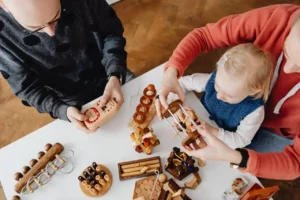
I really started Googling Toys to Develop Fine Motor Skills the day I watched my toddler trying to stack blocks… and missing every single time.
Her friend was already building little towers and doing cute knob puzzles, and my kid was mostly chewing on the blocks and knocking everything over like a happy baby Godzilla.
Cue the mom thoughts :
- “Should she be doing more with her hands by now ?”
- “Am I supposed to be buying ‘special’ toys ?”
- “Is throwing Play-Doh on the floor still development ?” (Asking for a friend.)
If you’ve ever stared at your toy shelf wondering which things actually help your child’s development—and which are just noisy plastic chaos—you are so not alone. I’ve been there too. 💛
Here’s the good news: you don’t need a room full of fancy stuff. Simple, well-chosen toys to develop fine motor skills can gently build the muscles and coordination your child needs for things like writing, buttoning, eating with utensils, and more. And a lot of the classics—blocks, beads, Play-Doh, puzzles—are exactly what child development experts recommend.
In this post, we’ll walk through :
- What fine motor skills are (in mom language)
- How to choose good fine motor toys
- Specific toy ideas by age (1–2, 2–3, 3–5)
- Budget-friendly and DIY alternatives
- When it might be worth checking in with a pediatrician or OT
Grab a coffee, peek at the toy basket, and let’s turn playtime into quiet, cozy skill-building time—without turning you into a Pinterest teacher.
In this article : [+]
1. Understand What Fine Motor Skills Are (and Why Toys Help)
Fine motor skills are the small, precise movements that use the muscles in your child’s hands, fingers, and wrists—often along with their eyes. Think about all the daily things they’ll eventually do :
- Holding a spoon or fork
- Turning pages
- Buttoning, zipping, snapping
- Cutting with scissors
- Drawing, coloring, and writing
These skills don’t appear overnight. They build gradually, from grabbing big objects to using a refined pincer grasp (thumb + index finger) to handle tiny things like beads or cereal pieces.
Fine motor development charts and milestone guides all basically say the same thing: kids get better with repetition, practice, and play.Kid Sense Child Development That’s where toys come in.
The right toys :
- Give little hands something interesting to grasp, pinch, push, pull, twist, and stack
- Help kids practice hand–eye coordination
- Build the strength and control they’ll later use for writing and self-care tasks
One study even found that early exposure to age-appropriate play materials was linked to better motor development in young children.
So yes—those blocks and beads matter more than we think.
2. How to Choose Toys to Develop Fine Motor Skills (For Any Age)
Before we dive into specific toys, here are a few simple guidelines to keep in mind when you’re choosing :
Look for “active kid, passive toy”
Early childhood experts suggest choosing toys that require your child to do something—twist, stack, pull, match—rather than toys that do all the work with lights and sounds.
Good fine motor toys usually :
- Don’t need batteries
- Can be used in more than one way
- Involve moving small parts with hands and fingers
Match the toy to your child’s stage
Toys should be challenging but not impossible. The National Association for the Education of Young Children emphasizes that “good toys” match a child’s age and stage—what’s perfect for a 3-year-old will frustrate a 1-year-old.
Think: grasp, pinch, twist, squeeze, build
If a toy encourages your child to :
- Pinch with fingers
- Squeeze with their whole hand
- Twist knobs or lids
- Thread or lace
- Stack and build
…then it’s probably a great fine motor toy.
Now let’s break it down by age.
3. Toys to Develop Fine Motor Skills for Ages 1–2
At this age, the focus is on grasping, releasing, and simple hand–eye coordination. Think big, chunky, and safe to mouth.
1. Stacking Cups and Big Blocks
- What they are : Large cups that nest and stack; soft or chunky wooden/plastic blocks.
- Why they work :
- Practice grasping, releasing, and controlled movement
- Great for early coordination and cause-and-effect (“Oh, it falls down when I knock it!”)
- How we use them :
My toddler could happily spend 20 minutes stacking cups, knocking them down, and handing me pieces to build with her. Zero batteries, endless play.
2. Jumbo Knob Puzzles
- What they are : Wooden puzzles with big pieces and large knobs for tiny hands.
- Why they work :
- Encourage pincer grasp (thumb + index finger) as they lift and place pieces
- Practice matching shapes and pictures
- Tips :
Start with simple puzzles (few pieces, clear images). Sit beside your child and help them turn pieces the right way.
3. “Fill and Spill” or Soft Basket Toys
- What they are : Soft baskets or containers filled with plush or crinkly objects that kids can pull out and stuff back in.
- Why they work :
- Grabbing, pulling, and pushing objects back in builds hand strength and coordination
- Encourages repetition, which toddlers love
- Bonus :
Great for car trips or quiet time because they’re soft and not super noisy.
4. Simple Activity Boards (Knobs, Buttons, Flaps)
- What they are : Boards with doors to open, knobs to turn, buttons to slide, latches to flip.
- Why they work :
- Practice finger isolation and wrist turning
- Build problem-solving skills: “What happens if I twist this?”
- Mom note :
These are the toys that kept my child busy while I drank coffee while it was still hot. I will be forever grateful.
4. Toys to Develop Fine Motor Skills for Ages 2–3
Now kids are ready for more challenge—pressing, pinching, pulling apart, and building with smaller pieces.
5. Play-Doh and Modeling Clay
- What it is : Classic squishy Play-Doh or homemade dough.
- Why it works :
- Rolling, squishing, pinching, and cutting dough build the little muscles needed for pencil grasp and scissor skills later.
- Supports sensory play and creativity at the same time.
- Ideas :
- Make “snakes,” tiny balls, pretend cookies
- Use plastic knives, cookie cutters, and stampers
6. Duplo-Style Building Blocks
- What they are : Large interlocking blocks that are easy to push together and pull apart.
- Why they work :
- Strengthen hand muscles as kids press and separate pieces
- Build coordination and spatial awareness
- How we play :
We started with “towers for animals” and “garages” for toy cars. Even if the builds are simple, their fingers are doing a ton of work.
7. Peg Boards and Posting Toys
- What they are : Boards with holes and chunky pegs; or toys where kids push shapes/pieces into slots.
- Why they work :
- Practice controlled, targeted placement (hand–eye coordination)
- Build finger strength and dexterity
- Tip :
You can add a color-sorting element (“Put the red pegs here, blue pegs there”) to sneak in some early learning.
8. Fine Motor Hedgehog / Quill Toys
- What they are : Toys where kids insert “quills” or pegs into holes on an animal or board. Some OT-recommended toys like these are specifically designed for fine motor work.
- Why they work :
- Great for practicing a pinch-and-place movement
- Help kids prepare for tripod grasp (thumb, index, middle finger)
5. Toys to Develop Fine Motor Skills for Ages 3–5
Preschoolers are ready for more precise tasks—threading, cutting, building with smaller pieces, and using tools.
9. Lacing Beads and Threading Toys
- What they are : Beads with large holes plus laces or strings; or lacing cards with holes to “sew” through.
- Why they work :
- Build bilateral coordination (one hand holds the bead/card, the other threads)
- Improve hand–eye coordination and pincer grasp
- Ideas :
- Make “bracelets” or “necklaces” for stuffed animals
- Lace around shapes like hearts, stars, or animals
10. Tongs, Chopsticks, and Fine Motor Games
- What they are : Kid-friendly tongs, chopstick-style tools, and sorting games with small pieces (like foam noodles or pompoms).
- Why they work :
- Strengthen tripod grasp and finger control
- Great pre-writing prep as kids learn to coordinate thumb, index, and middle fingers
- How we play :
We do “food rescue” from a bowl of pompoms, or “noodle restaurant” where my child uses tongs to serve “noodles” to toy customers.
11. Kid-Safe Scissors and Craft Kits
- What they are : Child-safe scissors, colored paper, stickers, glue sticks, simple craft sets.
- Why they work :
- Cutting strengthens hand muscles and improves bilateral coordination (one hand cuts, the other holds paper)
- Peeling stickers and squeezing glue sticks are also great fine motor work.
- Tips :
- Start with thick paper strips and let them snip fringe along the edge.
- Always supervise and store scissors out of reach when not in use.
12. Magnetic Tiles and Construction Sets
- What they are : Magnetic building tiles or small construction kits (larger pieces for 3–4, smaller as they get older).
- Why they work :
- Encourage careful placement, alignment, and gripping
- Combine fine motor work with problem solving and imagination
- Mom note :
These toys have kept my child and visiting cousins busy for hours. Castles, “aquariums,” garages—you name it.
6. Budget-Friendly Alternatives and DIY Fine Motor Toys
You absolutely don’t need to buy everything new. A lot of everyday items can double as fine motor “toys” :
- Muffin tin + pom-poms → color sorting and transferring
- Clothespins + paper plate → clipping “sun rays” or “porcupine spikes”
- Pasta or cereal + string → DIY lacing beads
- Buttons, coins (for older kids), or large beads → sorting by color/size
- Sponges + water → squeezing and transferring between cups
Occupational therapists often use very simple materials in sessions because it’s the movement that matters, not the brand name.
So if the budget is tight or the toy bin is overflowing, you can absolutely lean on household items.
7. Follow Your Child’s Lead (and Rotate Toys)
One of the best “tricks” I’ve learned is to rotate toys and follow my child’s interests.
- If they’re into animals → animal lacing cards, vet-themed Play-Doh, block “barns.”
- If they’re into vehicles → build garages with blocks, tape “roads” and use stickers as “road signs.”
- If they love pretend food → cutting food sets, tongs for serving, Play-Doh bakery.
Experts note that young children learn best when they’re engaged in active, hands-on play that follows their curiosity.
Rotating toys every week or so :
- Keeps things feeling “new” without constant buying
- Gives certain toys a break so your child actually notices them again later
- Lets you gently nudge toward fine motor skills while still honoring their favorite themes
8. When to Check in with a Pediatrician or Occupational Therapist
Toys can do a lot—but sometimes our gut tells us something more might be going on, and that’s worth listening to.
Consider bringing it up with your child’s pediatrician if :
- Your child avoids most hand tasks (stacking, drawing, feeding self)
- They seem much weaker or less coordinated with their hands than peers
- They get extremely frustrated by simple tasks like holding a crayon, stacking a couple of blocks, or picking up small objects
- They’re not meeting multiple fine motor milestones for their age (for example, struggling to stack two blocks around 18 months or use a fork/clumsy spoon by 2–3 years)
The CDC and pediatric organizations consistently encourage parents to talk to their child’s doctor if they’re concerned about any area of development—and that includes fine motor skills.
Early evaluation and, if needed, occupational therapy can make tasks like writing, cutting, and dressing much easier later on.
You’re not “overreacting” by asking. You’re advocating. There’s a big difference—and your child is lucky to have you.
You’re Doing Better Than You Think, Mama 💛
If you’ve read this far, it’s because you care—not just about Toys to Develop Fine Motor Skills, but about your child feeling confident in their little body.
Here’s what I want you to remember :
- You don’t need a perfect playroom or every trending toy.
- Blocks, Play-Doh, beads, puzzles, and a few clever household hacks can go a long way.
- The real magic isn’t in the toy itself—it’s in those everyday moments when you sit down, play together, and cheer on tiny victories.
Every tower they stack, every bead they thread, every wobbly line they draw is a quiet step toward independence. And you’re the one making that possible—by offering chances to play, explore, and try again.
You’re doing great. Truly.
Let’s Share Toy Ideas
I’d love to hear from you :
👉 What’s your child’s favorite toy right now that secretly works those little hand muscles—blocks, puzzles, Play-Doh, something random from the kitchen drawer?
Share it in the comments—your idea might be exactly what another mama needs to try this week.
If this post on Toys to Develop Fine Motor Skills was helpful, feel free to save it for later or share it with a friend. And if you’d love more cozy, judgment-free tips on child development, routines, and mom life, you’re always welcome to join my email list for weekly encouragement and real-life ideas you can actually use. 💌